
Click here to go straight to exercises
A Harlot’s Progress was a set of six paintings by the English artist William Hogarth made in 1731. These were very popular with the visitors to his studio but it was the series of six prints published in 1732 which were widely bought and captured people’s imagination. In fact, they made Hogarth famous. Unfortunately, the paintings were destroyed in a fire in 1755.
This series of pictures was one of Hogarth’s ‘modern moral subjects’ and the prints were published just after an official crackdown on prostitution had begun, focused specifically on Covent Garden. Prostitution was rife in Georgian London. In this series, Hogarth satirises 18th-century society’s hypocrisy, selfishness and brutality.
The prints show the story of a young woman, Moll Hackabout, who arrives in London from the country, alone and vulnerable, and is tricked into prostitution by a devious brothel keeper.
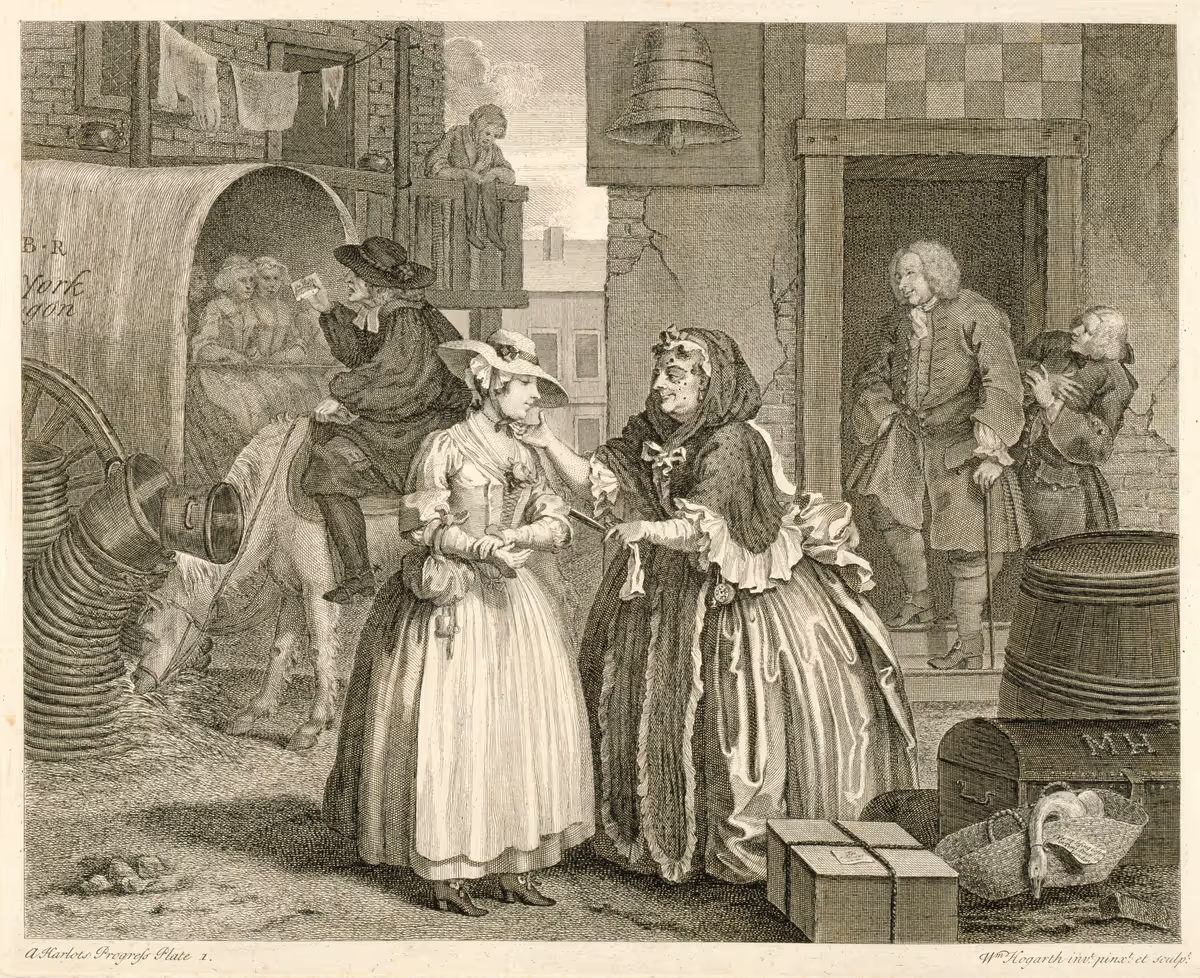
Plate 1
The first plate shows Moll arriving on a stagecoach from York outside the Bell Inn in London’s Cheapside. She is carrying scissors and a pin cushion on her arm which suggests that she is looking for a job as a seamstress. (A seamstress is a woman who makes a living from sewing.) Instead, she is greeted by the pox-ridden Elizabeth Needham, a notorious madam and brothel-keeper who is trying to persuade her to join her house of ill repute.
A house of ill repute is another way of saying ‘brothel’ or house for prostitutes. The black beauty spots on Elizabeth’s face are to cover her sores as she has syphilis.
Mother Needham was put in the pillory for running a disorderly brothel where the crowd stoned her and she died.
At the door to the brothel is the infamous rake, Colonel Francis Charteris and his pimp, John Gourlay. (‘Rake’ is an old-fashioned word for a rich man with very low morals. A pimp is a man who controls prostitutes and arranges clients for them, taking a percentage of their earnings.)
Colonel Charteris was a serial rapist and was convicted of raping his servant in 1730 and sentenced to death. However, his rich friends obtained his pardon. He died of natural causes shortly after.
The men are awaiting Moll’s arrival with anticipation. The building they are standing in front of is decaying, a symbol of the men’s moral bankruptcy. The figures in the picture were well known in 18th century London and would be easily recognisable.
Moll has brought a goose for her cousin, who fails to meet her. To the left, a clergyman is on horseback, too busy reading a letter to help Moll. He also ignores the fact that his horse is knocking over a pile of pans. The teetering pile of pans alludes to Moll’s imminent ‘fall’.
Moll is wearing white, in contrast to those around her, illustrating her innocence and naiveté. The dead goose, also white, foreshadows her death as a result of her gullibility.
Plate 2
Moll is now the mistress of a wealthy Jewish merchant, stereotyped by Hogarth with his thick, black eyebrows. Hogarth has also included two paintings in the background showing scenes from the Old Testament which probably foretell how the merchant will treat Moll in the future.
Moll has been given everything she could wish for by the merchant: fashionable clothes, fine furnishings, a black servant boy and a pet monkey. However, her lover can be seen sneaking out of the room in his socks with the help of Moll’s maid who is carrying his shoes. We can assume he has just left the canopied bed behind Moll who has distracted the merchant by kicking over the table. The merchant is shocked, as is the servant boy, but Moll looks playful and cheeky, perhaps believing she holds the power in this relationship, at least for the time being.
During this time it was fashionable for ladies to have young black slave boys to serve them tea. This was a tradition taken from colonialism. The young boys would be dressed up in exotic outfits, as would be the pet monkeys. Like the monkey, the boy is Moll’s exotic toy, just as Moll is the exotic toy of the merchant.
In the front of the picture, the monkey is running off with Moll’s hat and a piece of lace, towards a table with a mask. The implication is that Moll’s life is a masquerade.
The fact that Hogarth has included the slave boy, the monkey, the mahogany table and tea indicates that the merchant has made his money from the colonies.
Hogarth was critical of those who obtained their wealth from the transatlantic slave trade and also of the fashion for transatlantic commodities. He used his paintings and prints to satirise the moral weakness of people who consumed these ‘foreign’ goods and to expose the levels of exploitation he could see around him in London. He despised the hypocrisy of the colonisers who claimed to spread ‘civilisation’ around the world but failed to practise it at home.
The overall theme of Plate 2 is exploitation.
Plate 3
Moll has gone from kept woman to common prostitute. She has been discarded by the merchant and now lives in a shabby room in Drury Lane, Covent Garden. Her maid has syphilis and the cat poses to suggest Moll’s new posture. On the wall is a witch’s hat and broom. Her heroes are depicted in two paintings on the wall: Macheath from The Beggar’s Opera and Henry Sacheverell. Two cures for syphilis are above them.
The wig box of highwayman James Dalton, who was hanged on 11 May 1730, is stored on top of her bed, suggesting she was romantically involved with him. The magistrate, Sir John Gonson, with three armed bailiffs, is coming through the door on the right to arrest Moll for her activities. Gonson was an English judge noted for his enthusiasm for raiding brothels and passing harsh sentences.
Moll is showing off a new watch, perhaps a present from Dalton, or stolen from a client, and she is exposing her left breast.
Plate 4
Moll is now in Bridewell Prison. She is beating hemp to make rope. She is wearing much finer clothes than the other prisoners. The jailer is on the left, threatening her with a stick and pointing to the work she must do. The jailer’s wife, standing next to him, is stealing Moll’s clothes and winking at us. The man behind the jailer’s wife has his hands in the stocks. The message above reads: “Better to work than to stand thus.” Presumably, he has refused to work.
The well-dressed man standing to the right of Moll has dropped a playing card on the floor which suggests he could be a card-sharp (someone who uses skill or deception to win at card games) or maybe he has lost his money through gambling. He has brought his dog with him.
On the right, Moll’s former maid, who is probably wearing Moll’s fancy slippers, is pulling up her stocking and laughing at Moll. The woman next to her is picking lice out of her clothing.
Plate 5
Moll is now dying of syphilis in a squalid room. She is wrapped in a sheet by the fire to make her sweat while two well-known doctors, identifiable as Richard Rock and Jean Misaubin, are arguing about the best treatment. One seems to prefer bleeding while the other is suggesting cupping. Moll’s maid is horrified at the doctors and tries to stop them.
Moll’s teeth, lost through dosing with mercury, are lying on a paper on the right.
Another woman is rifling through the trunk Moll brought on the York wagon to see what she can steal. She could be the landlady or the brothel keeper.
Moll’s son sits by the fire waiting for his dinner and picking lice or fleas out of his hair. Some painkillers and “cures” can be seen on the floor.
Plate 6
The final plate shows Moll’s wake. She died aged 23 on 2 September 1731 as indicated by a note on the coffin lid. Most of the people present are prostitutes. They are not there to mourn Moll but to help themselves to whatever possessions remain. Moll’s son, sitting in front of the coffin, seems to be unaware of what is going on.
A woman is placing her drink on the coffin and the parson, a religious man, is spilling his drink without realising it. He is more occupied in putting his hand up the skirt of the woman sitting next to him. She doesn’t seem to mind and, in fact, appears to be hiding this activity with her hat. The woman to the right of the parson looks disapprovingly at what is happening.
Moll’s maid, on the right in front of the window, appears to be rather drunk but is trying to stop the disrespect being shown towards Moll’s dead body. She is being molested by the undertaker but is stealing his handkerchief at the same time.
On the far right, Moll’s madam (or brothel keeper) mourns her drunkenly. She has a grinning jug of “Nants” or brandy next to her.
In the middle, one prostitute is showing her injured finger to another and a woman behind them is looking at herself in the mirror.
The house holding the coffin has an ironic coat of arms on the wall. It shows a chevron with three spigots, or plugs, suggesting the parson spilling his drink, the free-flowing alcohol and Moll’s death.
The white hat hanging on the wall by the coat of arms is the one Moll was wearing in the first plate, referring back to the beginning of her end.
A Harlot’s Progress is a moral tale based on Hogarth’s observations of life in Georgian London. He satirises the behaviour of all classes: rich and poor and illustrates the hypocrisy he despises with humour and caricature – an early form of comic strip.
Text
Exercises











Leave a Reply