
Click here to go straight to exercises.
Southwark Fair was a major annual London street festival held in September from 1462 to 1762. It took place in Borough, near St George’s Church, on the south bank of the Thames and featured actors, acrobats and musicians. Originally, it lasted three days but expanded to two weeks by the 18th century. It was abolished in 1762 due to escalating public disorder.
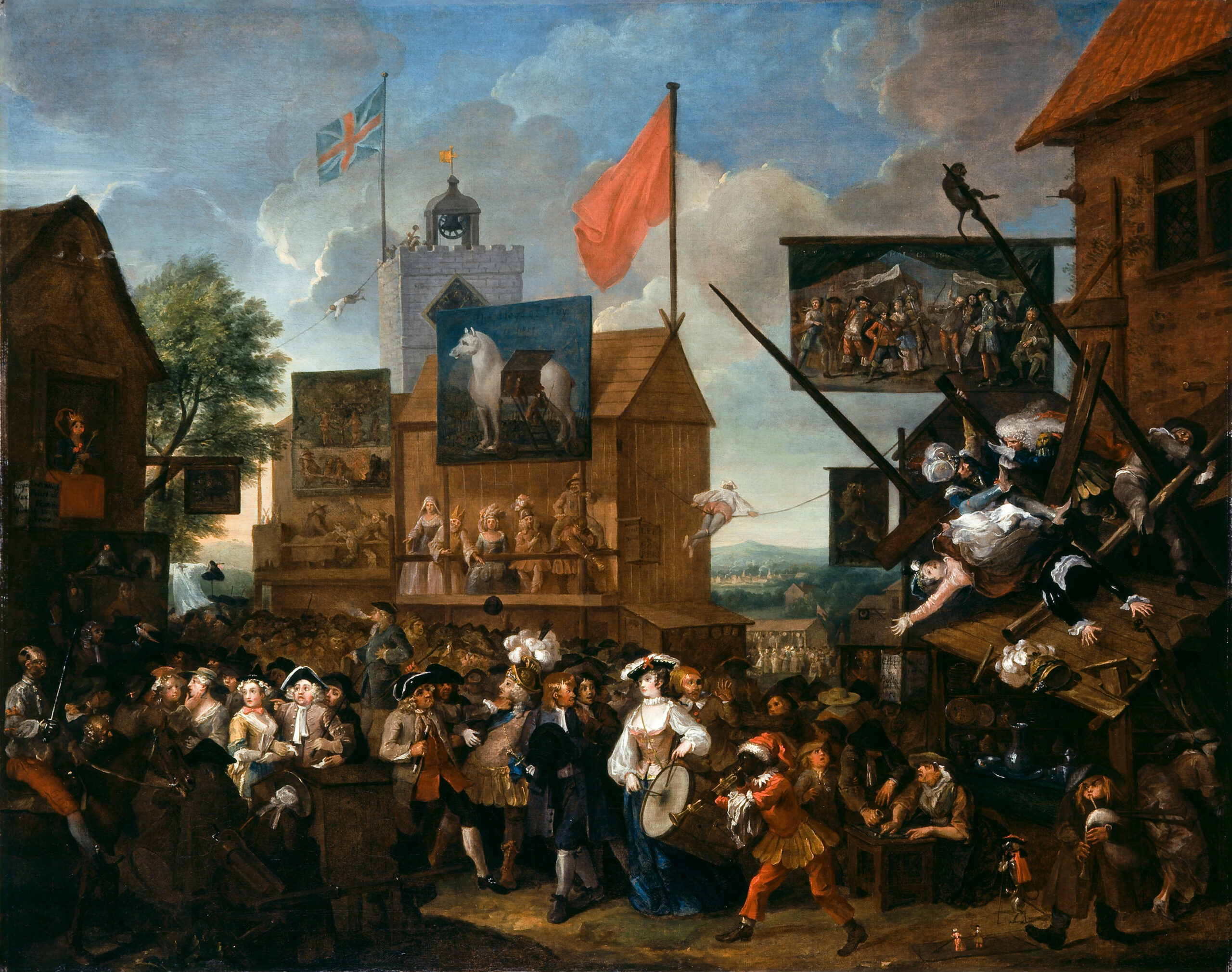
Hogarth painted the riotous carnival and captured the celebration, the diversity of people, incidents, noises and action. You can almost hear the hustle and bustle, the activity, the banging of drums and the stories being told. There are details everywhere. Hogarth’s works are a visual feast and they’re there to be read. They often contain references to contemporary figures and events which would be recognised by his audience.
Banners hanging from the buildings advertise various theatrical performances. On the left is the Drury Lane Theatre’s ‘Stage Mutiny’ which is a reference to a group of actors who defected to the Haymarket in protest at their new management. In the middle is the ‘Siege of Troy’ and, on the right, ‘Punches Opera’.
On the left, the play ‘The Fall of Bajazet’, was about to be presented. It’s a tragic play by Jean Racine in which the main character is ruined by deceit and disloyalty. Ironically, the stage is actually falling and you can see it’s falling onto a china shop underneath.
Street entertainers were a common attraction at fairs and several acrobats can be seen performing on high wires. The slack rope dancer, Signora Violante, swings on her rope hung between two buildings and the rope flyer, Thomas Kidman, has flung himself off the church tower.
On the right of the picture is the broken-nosed broadsword fighter, James Figg, sitting on his blind horse, brandishing his sword. In front of him two men are looking into a peep show.
Behind the prize-fighter a man is trying to procure two country girls into prostitution. One of them looks like Moll Hackabout from the series ‘A Harlot’s Progress’.
Next to them, a pickpocket is at work robbing a couple distracted by the activity nearby. This can be seen more clearly in the painting.
The central character is a female drummer who is advertising a troupe of street players. She is accompanied by a black musician playing the trumpet and an actor dressed as Julius Caesar is being accosted by the bailiffs. In between are two pickpockets gawping at the drummer.
On the right of the painting is a dwarf playing the bagpipes and next to him is a trained dog, walking on its back legs, dressed like a gentleman. To the left of the dog is a woman operating the ‘Find the Lady’ card fraud.
Southwark Fair was first a colour painting, then became a black and white print. To make a living, Hogarth made engravings of his work. Print copies were then made from these engraved images. It was these mass-produced pictures that were sold to the public. So Hogarth made Southwark Fair a portrait of the city that all Londoners could recognise and share and want to own.
Text
Exercises
Answers











Leave a Reply