Click here to go straight to exercises.
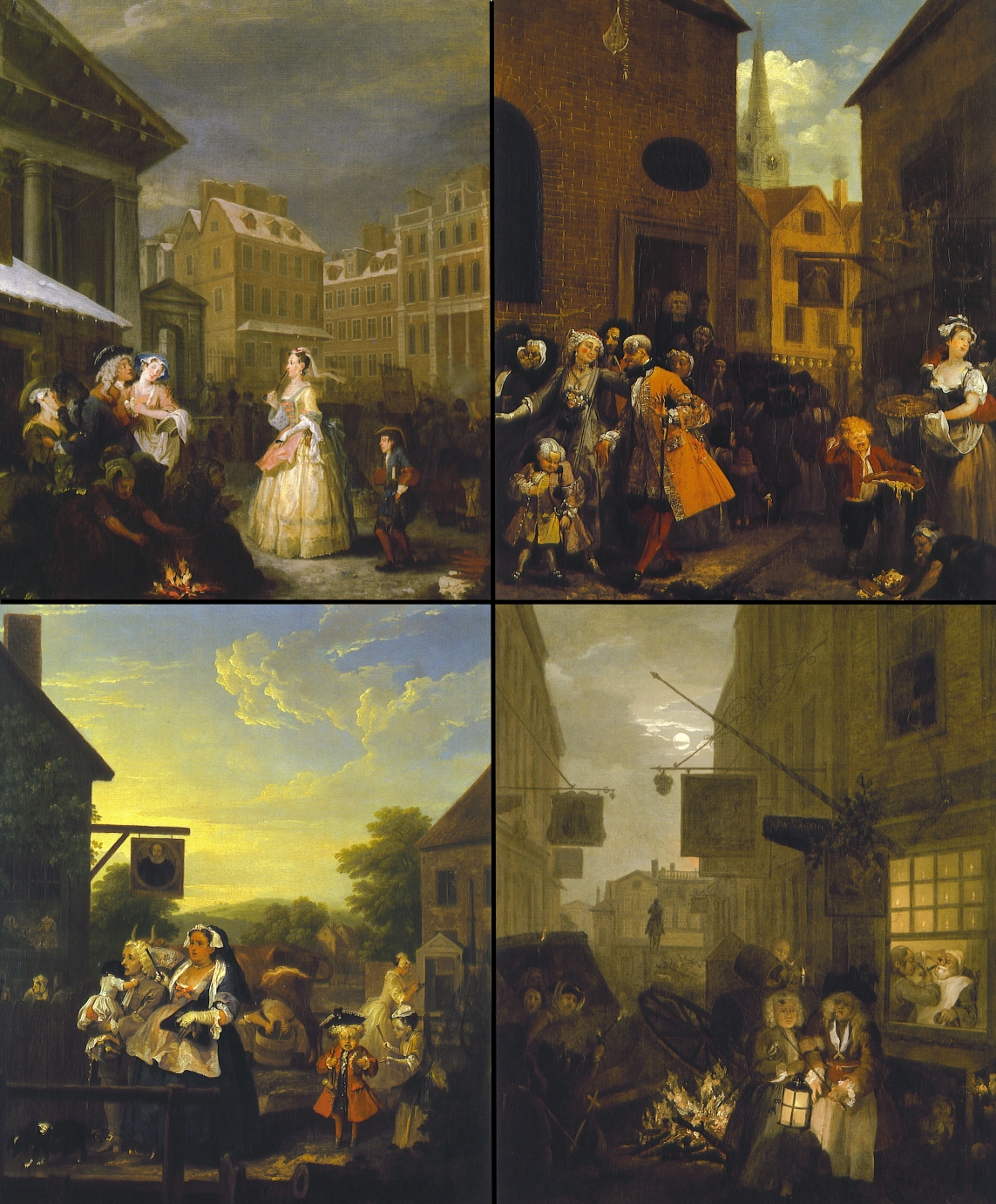
The Four Times of Day is a series of four oil paintings by English artist William Hogarth. The paintings were completed in 1736 and the engravings two years later. They are humorous depictions of life on the streets of London. Whereas some of Hogarth’s other series are meant as moral tales, these paintings present caricatures of contemporary figures and provide a glimpse of everyday life in 1730s London.
Morning
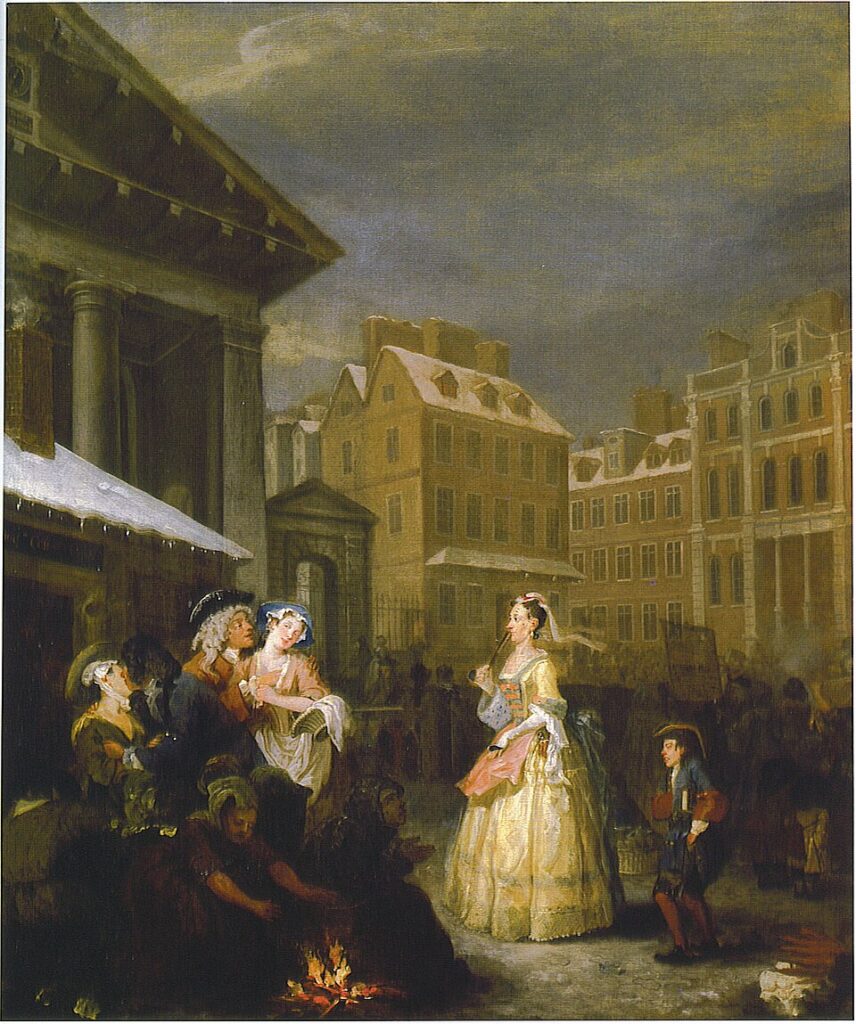
This scene is set in Covent Garden piazza early on a winter’s morning. An old lady, fashionably dressed, is on her way to St Paul’s Church. She is holding a fan to her mouth as she disapproves of the young people enjoying amorous activity in the street. It is likely that they have been up all night at a nearby establishment.
Tom King’s Coffee House is on the left, in front of the church. It was notorious for heavy drinking and prostitution. In the print the raised swords suggest that a fight is taking place and someone’s wig is flying out of the window. The coffee house was run by Tom’s widow, Moll King. Moll opened the doors once the taverns had shut, allowing the revellers to continue enjoying themselves from midnight until dawn.
In the foreground are a couple of old women: one is warming her hands by the fire and the other is begging for charity. She is ignored by the rich woman who is wearing a luxurious, spotted, ermine muff on her arm and a bright yellow dress which is too fashionable for a woman of her age. She is described as a spinster (an old, unmarried woman) and considered to be a hypocrite, ostentatiously attending church while showing no charity to her red-nosed, freezing servant behind her, carrying her prayer book, or the beggar in front of her. The figure of the spinster is said to be based on a relative of Hogarth, who, when recognising herself in the picture, cut him out of her will.
Behind the main characters, stallholders set out their fruit and vegetables for the day’s market. In the print, two children on their way to school have stopped to watch the activity of the market. A quack (someone pretending to be a doctor) is selling his medicine. On the advertising board, his name, Dr Rock, and the royal crest can be made out, which suggests that he supplies his medicine to the royal family. Hogarth’s opinion of Dr Rock is made clear in scene five of A Harlot’s Progress where he is seen arguing with another doctor over treatments for Moll Hackabout who is dying in the corner. Above the clock in the print can be seen Father Time, a figure holding a scythe and an hourglass, symbolising the transient nature of life.
Noon
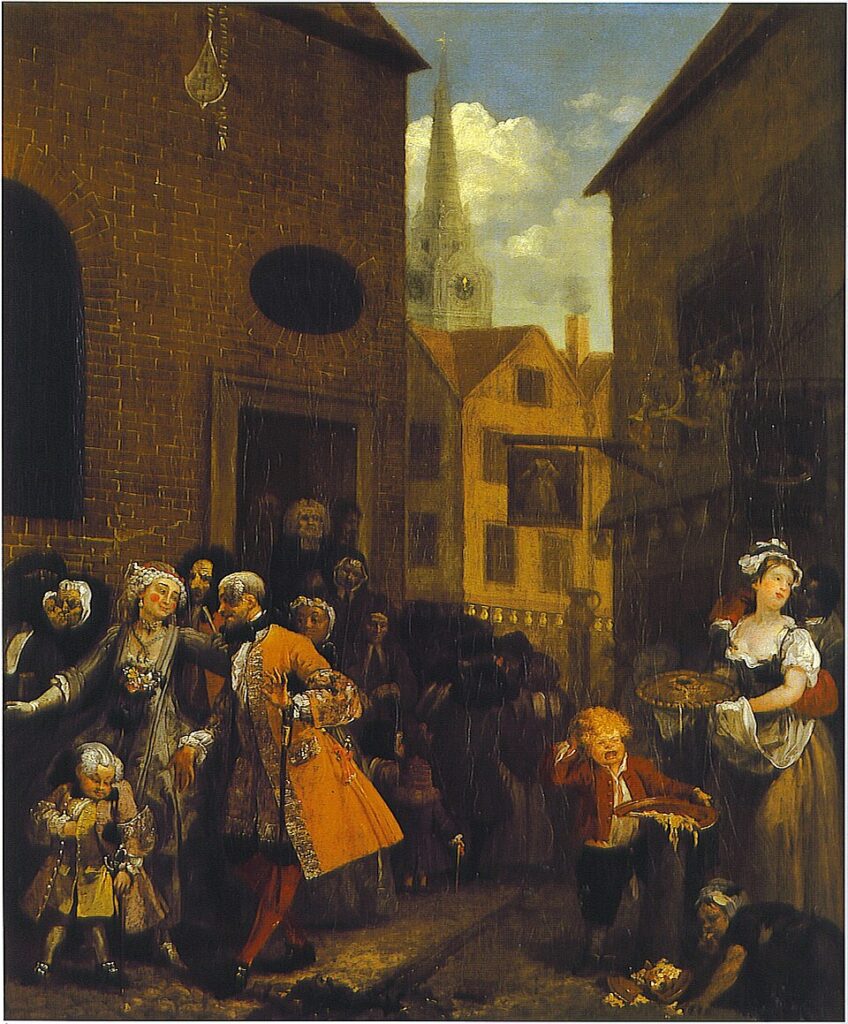
This scene takes place in Hog Lane, part of the slum district of St Giles with the church of St Giles-in-the-Fields in the background. The picture shows Huguenots leaving the French Church in Soho or the Huguenot Chapel on West Street, St Giles.
The Protestant Huguenot refugees had fled persecution in France and arrived in London in the 1680s. They brought with them valuable trades and set up as silversmiths, watchmakers and gunmakers in Soho and silk weavers in Spitalfields.
Hogarth contrasts two cultures in this spring-time midday scene in a crowded alley. The tension is between the misbehaving English on the right and the elegant French Huguenots leaving church on the left.
The middle-aged couple and their son at the front of the group are dressed in opulent clothes made of an excessive amount of very expensive imported silks, representing the latest French fashions. The older generation of Huguenot immigrants behind them are dressed in more conservative, plain dark colours.
On the other side of the alley, the English are gathered outside a pie shop. In the print version we can see the irreverent sign showing the head of Saint John the Baptist on a platter and an inscription below which reads: “Good Eating”.
A woman leaning out of the window above the pie shop is throwing a leg of meat out into the street as she argues with her husband who seems to be trying to stop her.
Under the pie shop sign a black man is fondling the breasts of a white woman, who is distracted from her work as her pie dish is spilling over.
Hogarth quite regularly showed people of colour in his pictures – sometimes as slaves or servants but also people who were free. There was legal ambiguity as to the status of enslaved people in England but there is evidence from magistrate courts that many slaves who escaped their captors were protected by the community. In 1764 the Gentleman’s Magazine estimated there were up to 20,000 black people in London.
In front of the couple, a boy has set down his pie to rest on a pillar, but the plate has broken and the pie has spilled onto the ground where a girl is scooping up the food and eating it.
Hogarth’s composition contrasts the immaculately dressed Huguenot family on one side of the alley with this rag-tag English ‘family’ of characters on the other side and he seems to be satirising both.
Hogarth regularly mocked the aristocracy’s craze for French fashions and he demonstrated this in his series A Rake’s Progress and Marriage à la Mode.
The symbolism in this image suggests that the lives of English people revolve around sex and food but, at the same time, there is humour and possibly fondness too for the chaos and disorder.
Evening
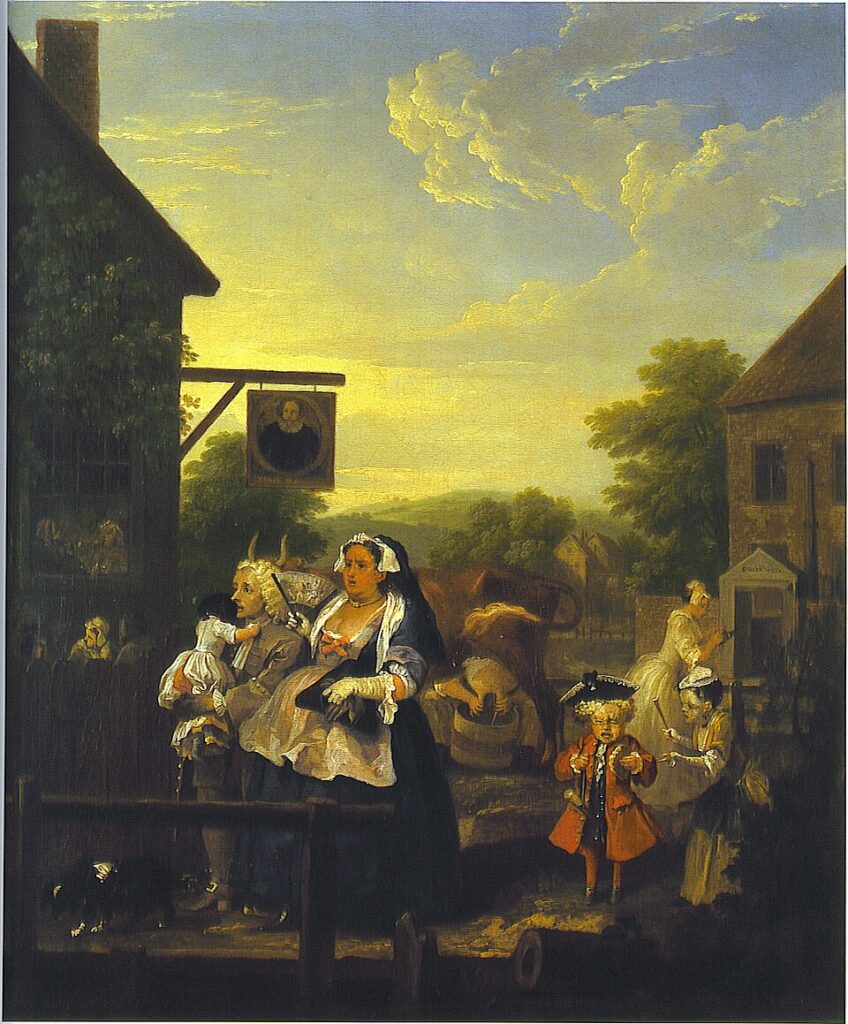
This scene is set outside the city centre with views of the countryside beyond. It is a hot summer evening, as hinted at by the woman fanning herself, and the cow being milked in the background indicates it is around 5 o’clock.
The couple have ventured out to the fashionable Sadler’s Wells Theatre, the entrance to which is on the right of the painting.
The wife is pregnant and the husband is carrying a young child. The cow’s horns appear to be sticking out of the husband’s head. These imply that he is a cuckold, in other words, his wife is guilty of adultery. Therefore the children may not be his. In addition, he is shown as being smaller than his wife which emphasises his submissive role in their relationship. A dog, also pregnant, drags along, exhausted, in front of the couple, reflecting the wife’s state.
The couple’s older children follow on behind. The boy has his father’s cane between his legs as a hobby horse and the daughter is demanding he hand over his gingerbread, which is making him cry. The children seem to be mimicking the roles of their parents and Hogarth seems to be making fun of the idea of the perfect, loving nuclear family.
The family are rushing home, past the New River and a tavern with a sign showing Sir Hugh Myddleton, who nearly bankrupted himself financing the construction of the river to bring running water into London in 1613.
Through the window of the tavern customers can be seen enjoying drinking away from the oppressive heat of the city. Hogarth is poking fun at these people escaping to the country for fresh air, only to reproduce the smoky air and crowded conditions of the city, in the pub, huddled together with their pipes.
Night
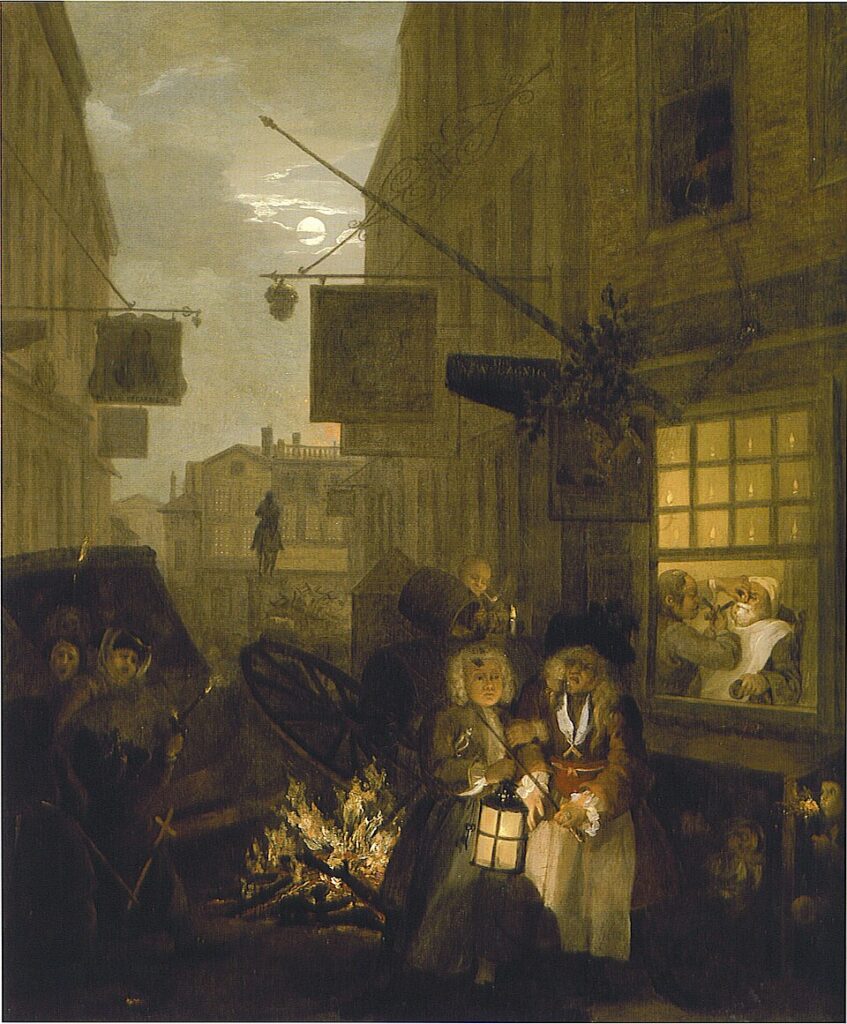
This is a moonlight scene in a narrow lane leading from present-day Whitehall to Charing Cross with the statue of Charles I in the distance.
The oak leaves decorating the barber-surgeon’s striped pole, the oak leaves on the Freemason’s hat, the bonfire in the street and the fireworks all suggest that the date is 29 May or Oak-Apple Day, a public holiday which celebrated the Restoration of the Monarchy, Charles II’s birthday and his escape on 3 September 1651.
The English Civil Wars took place between 1642 and 1651. King Charles I was executed in 1649 and his son, Charles II, did not ascend to the English throne until the restoration of the monarchy in 1660. After losing the Battle of Worcester in 1651, Charles II hid in the Royal Oak tree in the woodland of Boscobel House in Shropshire for one day to escape Parliamentarian soldiers.
In the print, the Rummer Tavern is on the left (a rummer is a type of glass, as can be seen on the pub sign, along with a bunch of grapes) and the Cardigan’s Head is on the right. Masonic lodges met in both taverns during the 1730s. A masonic lodge is where Freemasons meet. Freemasons are members of a tight-knit group of men who promise to help and support each other anywhere, at any time. They carry out secret and symbolic rituals. Hogarth was a Freemason.
Next to the Rummer Tavern is a sign saying: “The New Bagnio” and next to the Cardigan’s Head is a sign saying: “Bagnio”. Bagnios started out as Turkish baths but soon became known as brothels, or disorderly houses.
At the front of the print, on the left, is a drunken Freemason identified by his apron and set square medallion as the Worshipful Master of a lodge. He represents Sir Thomas de Veil, who was a member of Hogarth’s first lodge. He was unpopular for his harsh sentencing of gin sellers, which was hypocritical given he was known to be an enthusiastic drinker. He is supported by his Tyler, an officer of the lodge, who is equipped with a sword. A chamber pot is being emptied onto his head by someone in an upstairs window.
Behind the Freemason and his Tyler, a publican is adulterating the wine (adding something to it to reduce the quality).
Through the barber-surgeon’s window we can see a man being shaved. The sign reads: “SHAVING, BLEEDING, TEETH DRAWN”. The barber is holding the customer’s nose and blood is dripping down his chin onto the cloth which suggests that the barber is drunk or careless.
Under the shop window, a couple is sleeping on the street. Next to them is a link-boy, whose job it was to carry a flaming torch to light the way for pedestrians at night.
On the right of the print, the bonfire has caused the Salisbury Flying Coach to overturn. Street urchins are playing with the fire and one of their fireworks is falling in through the coach window.
In the background, a passing cartload of furniture implies that tenants are escaping from their landlord without paying the rent and doing a “moonlight flit”. The whole scene is one of chaos and disorder, which Hogarth seems to relish.
Text
Exercises
Answers











Leave a Reply