Click here to go straight to exercises
William Hogarth was an English painter and printmaker, born on 10 November 1697 in London. He is famous for creating pictures that tell stories about everyday life in 18th century Georgian Britain which was openly and often shockingly rude. His work included humour and satire and could sometimes be quite brutal.
Hogarth had to be careful with the rudeness in his works of art because he lived in a world where the Church was very powerful, the aristocrats dominated society and the big city merchants were becoming increasingly powerful too. Respectability was important to all of them and Hogarth needed them to buy his paintings. Nevertheless, he did not like hypocrisy and painted pictures that showed all classes of society, often behaving very badly.
His pictures were inspired by the people and things he saw around him but in order to show the more shocking stories, he had to provide moral outcomes.
He pioneered a new art form: the multi-part series focusing on urban characters which Hogarth called his “Modern Moral Subjects”. They all originated as paintings but were turned into engravings so that print copies could be made and sold to the middle and lower classes who previously could not afford to buy art. In this way, he could make his art accessible to all and make a good income at the same time.
Early Life
William Hogarth was born in Bartholemew Close, Smithfield. He was the fifth of nine children but only he and his two sisters grew to adulthood.
His mother was Anne Gibbons and his father was Richard Hogarth. His two surviving sisters were Mary and Ann.
Richard was a Latin teacher but, unable to make enough income from teaching, he opened a coffee- house. It was not a success and in 1707 he was confined to Fleet Prison for debt.
He was released five years later during an amnesty. This incident remained with William Hogarth throughout his life and it influenced his artworks which often showed the struggles of ordinary people.
In 1714, when William was sixteen, he was apprenticed to the gold and silver engraver Ellis Gamble, based at Leicester Fields. As an apprentice, Hogarth learned how to cut designs into metal so they could be printed onto paper. This skill helped him become a successful printmaker and he set up his own business in 1720.
Becoming an artist
Hogarth was sociable and enjoyed observing human behaviour. He knew the exuberant life of the London Streets, bawdy houses (an old-fashioned word for brothels – houses of sex workers), fairs and theatres and he sketched what he saw. At the same time, he was drawn to the coffeehouses and taverns frequented by writers, musicians, actors and liberal professionals, and he made friends with the intellectuals of the time.
He joined the newly-opened art academy at St. Martin’s Lane where he drew from casts and live models and met members of London’s small artistic community. He didn’t like copying so instead trained his visual memory so that he could draw or paint directly on paper or canvas what he had seen in real life.
In 1725 Sir James Thornhill, the greatest British artist of the time, responsible for the spectacular decoration of the inner dome of St. Paul’s Cathedral and the Painted Hall at Greenwich, opened a free school for artists at his home in Covent Garden. Hogarth joined the group and sometimes acted as an assistant, finishing details of some of Thornhill’s commissions.
Marriage
From his time at the academy, Hogarth knew Thornhill’s daughter Jane. In 1729, when Hogarth was 32 and she still only 19, Hogarth obtained a marriage certificate and three days later they married at the parish church in Paddington, without the consent of Jane’s father.
Despite an initial rift, Hogarth and Thornhill were later to become friends and collaborators. Hogarth and his wife did not have children but they fostered foundling children. (Foundling children were abandoned children who were cared for by institutions. Most were illegitimate, born to poor, unmarried mothers who could not support them due to extreme social stigma.)
Early artworks
By the mid-1720s Hogarth was producing pictures of a theatrical nature. He painted a scene from the English stage play The Beggar’s Opera in 1728-9.
The majority of the nearly 30 paintings he produced between 1728 and 1732 were ‘conversation pieces’, family group portraits.
A Harlot’s Progress
What was becoming clear by the beginning of the 1730s was Hogarth’s increasing ability to visually tell a dramatic story through a group of characters and their theatrical setting. What began as a simple sketch of a Drury Lane prostitute and her servant in 1730 attracted favourable comments. Hogarth was encouraged to gradually extend it into a series of six paintings called A Harlot’s Progress. ‘Harlot’ is an old-fashioned word for a prostitute or sex worker.
In A Harlot’s Progress, completed in 1732, Hogarth tells the story of a young woman, Moll Hackabout, who leaves her life in the countryside for the allure of the city, only to be trapped in a life of degradation and despair. Each of the six pictures acts much like a scene in a play, with the drama played out through the actions of the individual characters. Each scene serves as a moral warning about the consequences of vice and corruption. Not only was it an everyday and contemporary story that Londoners could relate to but it also featured people who were well-known to the public because they were recently involved in scandals. Even people who were unable to read and write could follow the stories in the pictures.
The original set of paintings of A Harlot’s Progress were exhibited at Thornhill’s home in the spring of 1732 and caused a sensation, bringing critical acclaim for combining satire with fine art, and made a celebrity of Hogarth. Many satirical and humorous prints were being produced at the time but A Harlot’s Progress was something new and original that Londoners had not seen before. Hogarth invited subscriptions to a series of prints, word spread around London, and he was quickly enjoying a healthy income of up to £100 per week. Unfortunately, the original paintings of A Harlot’s Progress were destroyed in a fire at Fonthill House in 1755.
Moving home and business
William and Jane were still living at her father’s house. By then Hogarth was earning at least £1,300 a year from the sale of prints, paintings and various commissions, a large income by the standards of the day. It was time to set up in his own premises so in 1733 they moved away from the increasingly disreputable Covent Garden and into a new home and studio, “The Golden Head”, at the nearby salubrious and fashionable Leicester Fields, the modern-day Leicester Square.
Southwark Fair
Hogarth painted the crowded canvas of Southwark Fair in 1733-34. It captures the riotous carnival which took place in Borough, near St. George’s Church, on the south bank of the Thames. It celebrates the diversity of people, incidents, noises and action. You can almost hear the noise, see the stories being told and feel that you are present in the scene.
A Rake’s Progress
In 1735 A Rake’s Progress was Hogarth’s follow-up to A Harlot’s Progress and the paintings can be seen in Sir John Soane’s Museum. ‘Rake’ is an old-fashioned word for a rich, fashionable man with immoral habits. A Rake’s Progress follows the ill-fortunes of Tom Rakewell. It moves from the time he inherits his late, miserly father’s fortune, through the squandering of his money on prostitution and gambling, his imprisonment for debt in Fleet Prison (where Hogarth’s own father suffered the same fate), to his confinement in Bedlam (a mental hospital of the time) due to his descent into madness.
St. Bartholomew’s Hospital
When Hogarth heard in 1734 that the governors of St. Bartholomew’s Hospital wanted some large-scale historical paintings to decorate the main stairwell of their new wing, he offered to carry out the work for free. He had three main aims: he wanted to show that an English artist was capable of producing such large-scale biblical scenes in the Grand Style; he had a genuine philanthropic desire to contribute to the hospital; and he wanted to have his work seen by prospective clients in a prestigious location. He was subsequently elected as a governor of the hospital, with his paintings accepted in lieu of a donation. (The two paintings have recently been restored and are on display in the hospital.) This very public support for Bart’s helped him to secure several private commissions for portraits of eminent physicians practising in London in the 1730s and 40s.
Engravers’ Copyright Act
When the success of A Harlot’s Progress resulted in numerous pirated copies by unscrupulous print sellers, Hogarth lobbied in Parliament for greater legal control over the reproduction of his and other artists’ work. The result was the Engravers’ Copyright Act (known as ‘Hogarth’s Act’), which became law on 25 June 1735 and was the first copyright law to deal with visual works and recognise the rights of individual artists.
The Four Times of Day 1736-38
For The Four Times of Day of 1736-38 Hogarth produced a series of paintings that were later engraved, each of which progresses through both the times of day and the seasons. Once again, he produced works that combine serious social commentary and humour, this time creating drama from everyday London scenes within a classical artistic theme.
The Foundling Hospital
From the late 1730s Hogarth painted a number of portraits. By 1740 he had mastered the genre, as seen in that of Captain Thomas Coram, Hogarth’s first full-length portrait. The two men had a lot in common. They both came from humble origins and had to make their own way in the world. Both were childless yet fond of children. Each in his own way fought for the rights of the underprivileged and exploited. Both attacked hypocrisy and injustice in the social order.
The shipwright and businessman Coram had spent many years lobbying and petitioning for the establishment of a hospital for abandoned and poor children. Unmarried mothers were scorned by society and often had to abandon their children because they couldn’t afford to look after them.
He set up the Thomas Coram Foundation for Children and Hogarth became a founding member of the board of the Foundling Hospital.
Having provided his portrait of Coram to the orphanage, Hogarth soon realised the potential of the institution as a way of promoting the work of British artists. He and several others presented historical works to hang in the Court Room of the new building at Bloomsbury, thus creating the earliest public art gallery in London. This ensured that the works would be seen by the aristocratic and wealthy patrons of the Hospital, who might commission works of art for themselves. More importantly, it was out of the artists’ annual meetings that the idea grew of holding an annual exhibition of British art – an idea that led eventually to the founding of the Royal Academy.
Self-Portrait
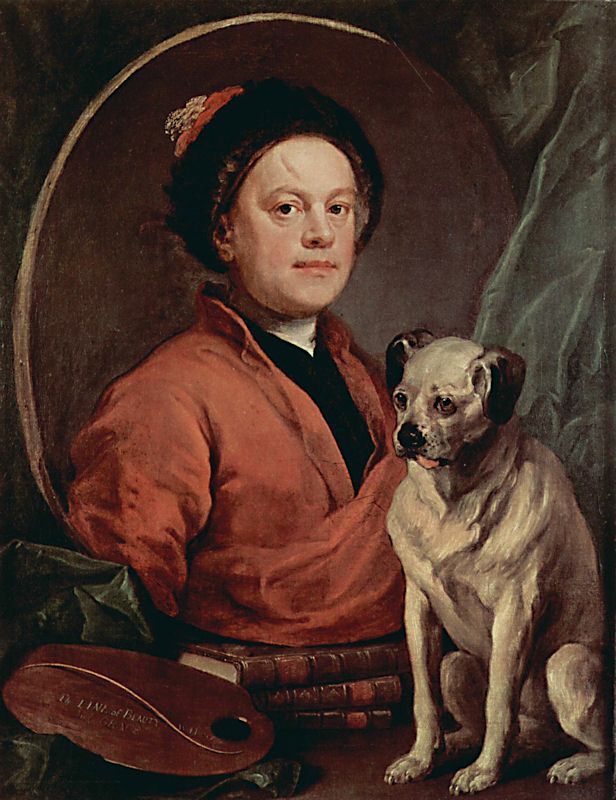
Hogarth’s famous self-portrait of 1745 marked a high point in his career. He included his pug dog, Trump, and books written by the great English writers William Shakespeare, John Milton and Jonathan Swift beside a palette inscribed with the sinuous “line of beauty”, his symbol for the variety and expressiveness of Nature.
Marriage à la Mode
In the early 1740s Hogarth returned to what he was best-known for, creating a third series of paintings to follow A Harlot’s Progress and A Rake’s Progress. Marriage à la Mode, a series of six paintings, is a commentary on arranged marriages among the rich. Hogarth presents a satirical view of the behaviour of the wealthy, upper classes and the hollowness of high society. The series illustrates the pitfalls of a marriage based on financial gain rather than love.
O the Roast Beef of Old England (‘The Gate of Calais’) 1748
Hogarth visited France in 1748 and while sketching the fortifications at Calais was suspected of spying and arrested. This is shown by an officer’s hand on his shoulder at the left of the painting.
Hogarth represents the French as a rabble of scrawny soldiers and a fat friar, salivating over a haunch of beef imported for the British. Hogarth contrasts France with an England where everyone eats roast beef and not watery soup.
The March of the Guards to Finchley 1750
The March of the Guards to Finchley is yet another of Hogarth’s paintings that could easily be set on a stage.
The drama is set in 1745 at Tottenham Court Road – then on the edge of London – as troops assemble for their march to confront ‘Bonnie Prince Charlie’ and his army who were marching towards London. Hogarth offered the painting in the form of a lottery prize. The unsold lottery tickets went to The Foundling Hospital who turned out to hold the winning ticket. The painting remains on display today at the Foundling Museum.
Chiswick
From the time of their marriage, William and Jane had rented summer lodgings but in September 1749 they purchased a country house close to the Thames in the quiet village of Chiswick.
Beer Street and Gin Lane
In 1751 the Gin Act was being passed by Parliament to try to combat the rampant addiction to the drink which was mainly consumed by poor people trying to escape their terrible living conditions.
Hogarth engraved Beer Street to show a happy city drinking the ‘good’ beverage, English beer, in contrast to Gin Lane, in which the effects of drinking gin are shown. As a more potent liquor, gin caused more problems for society. People are shown as healthy, happy and prosperous in Beer Street, while in Gin Lane they are scrawny, lazy and careless. The woman at the front of Gin Lane, who lets her baby fall to its death, echoes the tale of Judith Dufour, who strangled her baby so she could sell its clothes for gin money. The prints were published in support of the Gin Act 1751.
The Humours of an Election
By the 1750s Hogarth was reaching the peak of his artistic and satirical achievements, as can be seen in the last of his ‘moral subject’ series of paintings, The Humours of an Election, which mocked the corrupt British election system of the time. The series of four oil paintings can be seen in Sir John Soane’s Museum.
Self-portrait 1757-1758
In this self-portrait, Hogarth presents himself at home, wearing a soft cap instead of a wig, and painting at an easel. The outline on the canvas shows that it is Thalia, the Greek Muse of Comedy. Thalia symbolises joy and playfulness expressed through humour and storytelling. Hogarth invented comic history painting.
X-rays have shown that originally there was a live model on a low platform and a pug in the bottom left corner urinating on a pile of Old Master paintings.
Later life and legacy
In July 1763 Hogarth had a paralytic seizure but the following year he started work again and in April 1764 produced his final print Tailpiece: The Bathos in which he depicted the end of his own artistic world. He intended it as the end piece to the bound collection of his prints. The figure of Time, slumped next to a cracked palette and clutching a burning copy of The Times newspaper, is often interpreted as Hogarth expressing his exhaustion, isolation and despair at the frequent attacks on his work, and maybe even forecasting his own death. He died on 26 October 1764.
Hogarth was a pugnacious man who was independent in his thinking and in his methods of art. He was eager to fight any members of the London art world with whom he disagreed and he was often mocked by critics who did not like his work. However, he made a number of friends who remained loyal.
Nevertheless, he died a bitter man at his home in Leicester Fields and was buried in the graveyard of St. Nicholas Church in Chiswick.
Following her husband’s death, Jane Hogarth took over his print-selling business, successfully managing the publication and sale of his works for many years. Following the expiry of her husband’s copyrights in 1787, she was awarded a pension by the Royal Academy despite William’s refusal to become a member.
Hogarth’s house in Chiswick is now a museum. It is next to one of London’s best known road junctions – the Hogarth roundabout. His works are still displayed in major museums, including Tate Britain and The National Gallery in London.
Text











Leave a Reply