Click here to go straight to exercises.
Humours of an Election is a series of four oil paintings and later engravings by William Hogarth that illustrate the election of a Member of Parliament in Oxfordshire in 1754. The paintings were created in 1755. The first three paintings demonstrate the corruption in parliamentary elections in the 18th century, before the Great Reform Act. The last painting, Chairing the Member, shows the celebrations of the victorious Tory candidates and their supporters.
At this time each constituency elected two MPs, and only men who owned property could vote, in other words, only a small proportion of the population. There was no secret ballot so bribery and intimidation were common. There were only two political parties: the Tories and the Whigs.
Hogarth satirises the election process which is based on the greed and dishonesty of both the candidates and the electorate.
The paintings can be seen in Sir John Soane’s Museum in London.
1. An Election Entertainment
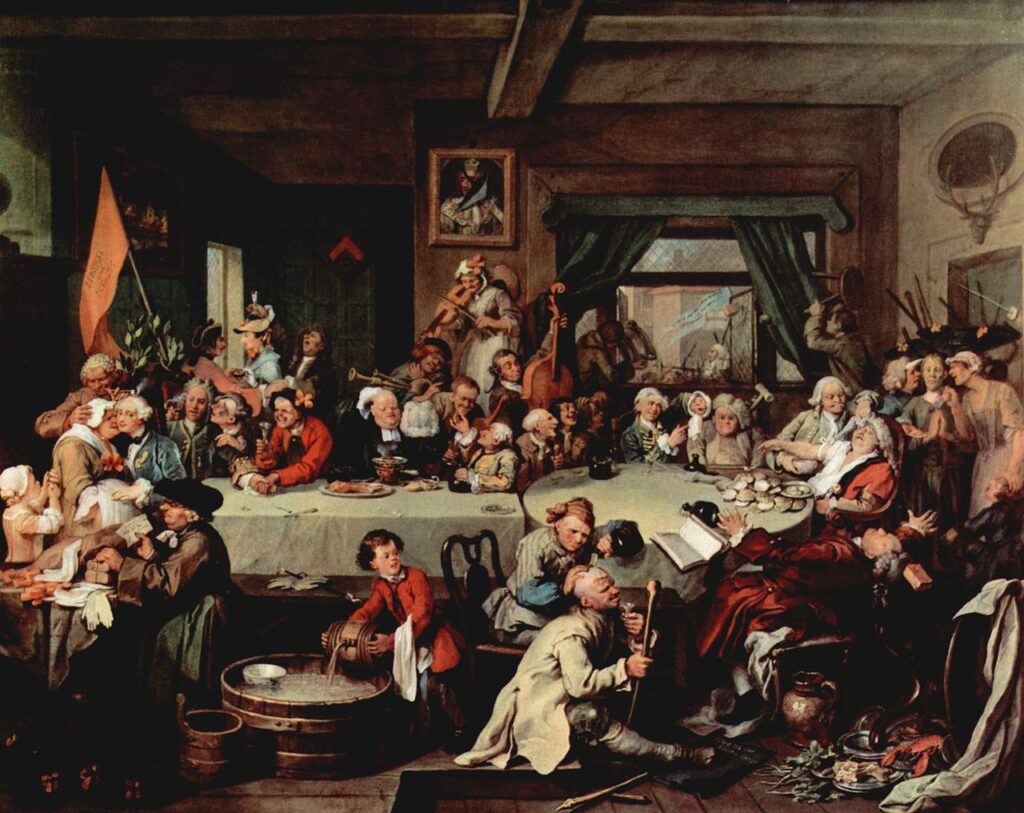
The setting for the first scene is an inn in the fictional town of Guzzledown. (To guzzle something down means to eat or drink something greedily.)
The two Whig parliamentary candidates have invited the town’s eligible voters to an ‘entertainment’ or feast where there is free food and drink. It is effectively a bribe as they hope the people at the entertainment will vote for them.
The Whig party’s motto ‘Liberty and Loyalty’ is emblazoned on an orange flag on the left of the painting while its colours, small orange rosettes, are piled on a table on the left at the front, worn by some of the attendees and fixed to the walls. Orange was probably chosen in reference to William of Orange whose portrait is on the wall to the left of the window. The portrait has been slashed which suggests that the room had previously been rented by the Tories for their ‘entertainment’. The ‘entertainments’ became more and more extravagant as the political parties tried to outdo each other.
The two candidates are on the left, indicated by the laurel leaves above their chairs. The younger one is exquisitely dressed and his handsome appearance is in contrast to the ugly pregnant woman he is reluctantly embracing. Standing above them is the woman’s husband, his pipe at risk of setting the candidate’s wig on fire. He is pressing his wife and the candidate close together as their daughter stares open-mouthed at the candidate’s diamond ring.
The other candidate is listening to a drunken bore and a drunken cobbler, clearly a supporter given the orange rosette he is wearing, is clasping the candidate’s hand. In almost no other situation would tradesmen be able to get so close to and be so familiar with such gentlemen of high social status but because the candidates are so keen to collect votes the usual social conventions are abandoned.
Greed is all around the table. Next to the cobbler is an enormously fat cleric, sweating from overeating, who has removed his wig. At the opposite end of the table to the candidates is the mayor, his black-trimmed red robe slipping off his shoulders as he sits slumped in his chair. He is being bled by the barber-surgeon following his collapse after gorging himself on oysters. To the mayor’s right sits a plainly dressed man, crippled by gout, probably caused by excessive drinking. He has a wide-eyed look on his face and probably needs the use of the chamber pot being emptied out of the window behind him.
Outside the window Tory supporters are protesting and waving their banners. They are trying to attack the Whig supporters with sticks. Violence was often associated with the process of electioneering at this time.
Two bricks have been thrown through the window; one has knocked the Whig party secretary backwards off his chair. In the ledger he has been keeping records: ‘Sure Votes’ – only one – and ‘Doubtful Votes’, of which there are many.
To the left of the secretary, seated in the foreground, are two ‘bruisers’ employed by the Whigs to force people to promise to vote for them, as indicated by the large staff (stick) one is leaning on. He has been wounded in the course of his ‘duty’ and is drinking a small amount of gin to make himself feel better. His colleague, a butcher by trade, is pouring alcohol onto his head to clean the wound.
The scene depicts numerous corrupt practices. Behind the candidates stands a beautiful young woman wearing an orange rosette, clearly a Whig supporter. She is being given a snuffbox by a red-coated soldier who is shaking hands with a drunken alderman at the same time. The alderman standing behind her is raising his glass over her head, inferring that she has traded sexual favours for a vote.
In the foreground on the left is Abel Squat. He is dressed in plain Quaker clothes and is sitting at a table piled high with gloves and stockings to be used as gifts for the wives of potential voters. He is reading a paper promising to pay him £20 in six months’ time.
On the opposite side of the painting is a Puritanical tailor, grey and hollow-eyed, his hands together in prayer instead of reaching out to accept the gold coins he is being offered by one of the Whig agents. He is the only person in the room not being tempted by the greed, violence and corruption. However, he is clearly not getting enough food and his son needs new shoes so his wife is chastising him for not accepting the money they desperately need.
Clearly, the attendees at this ‘entertainment’ are having ‘a whale of a time’, eating and drinking to excess, and being serenaded by a band of musicians. The woman at the back playing the fiddle is apparently a portrait of ‘Fiddling Nan’ who was well-known in Oxfordshire. The bass player seems to be doing his own thing and the viol player has stopped playing and is hoping to be offered a free glass of wine by the effeminate-looking gentleman. The bagpipe player is scratching for fleas.
2. Canvassing for Votes
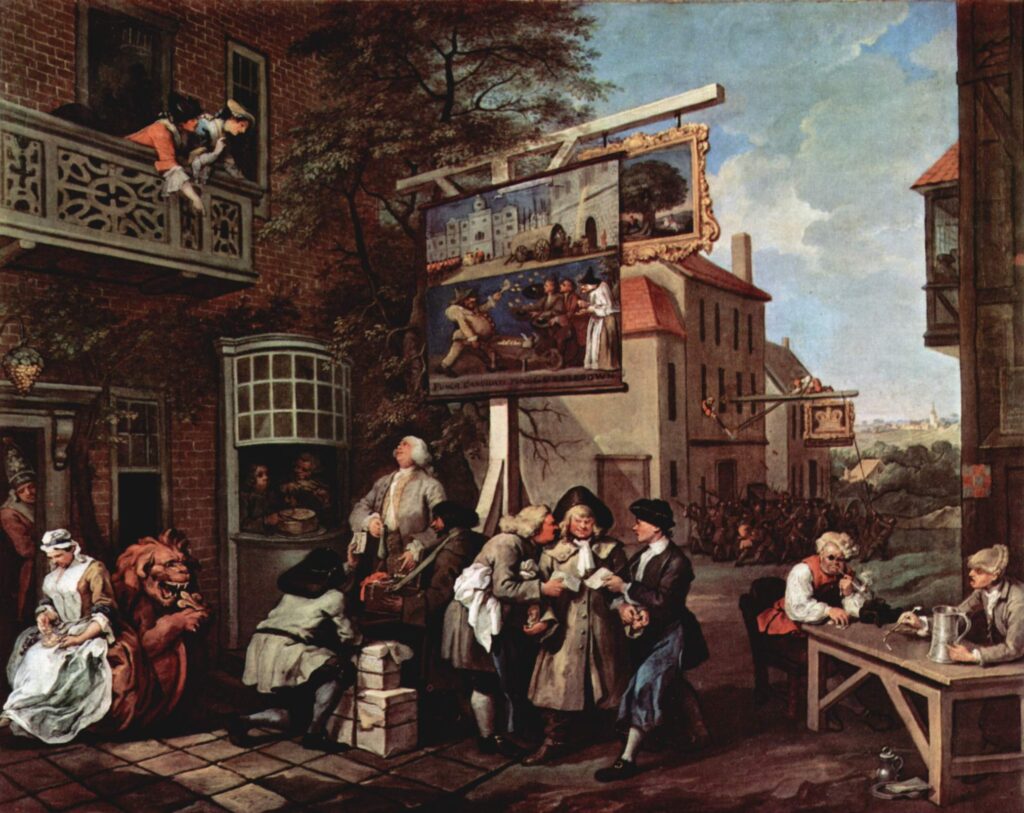
Scene two is set in the countryside, with green hills and a church in the distance. There are three inns in the picture representing the two political parties: the Tories and the Whigs and the third one representing the Independents.
The Whigs, who are the challengers in the 1754 Oxfordshire election, are represented by the inn the furthest away called The Crown. This is intended to reflect the Whigs’ interest in the ‘court’. A panel labelled ‘The Excise Office’ has been hung under the inn sign which is a reference to the Whigs’ taxation policy and suggests that this inn may also serve as a temporary tax office.
In front of The Crown are a rowdy mob armed with sticks, unhappy with the sign and the taxes it represents. They are attempting to pull down the sign: one man is sawing at the support and two others are pulling on it with a rope. What they don’t seem to realise is that the man on top of the sign and the sign itself will come crashing down on the people below. In addition, there’s a man hanging out of a window shooting at the crowd.
The inference of this small scene is that while the lower classes are raging against the imposition of taxation, they don’t seem to realise that some degree of taxation is necessary for the running of the state.
In the foreground is another inn, the prosperous looking Royal Oak, the Tory headquarters, built in the fashionable classical style. Even the inn sign is set in a frame mimicking one of the fashionable rococo picture frames of the day.
In a room on the upper floor, lit by a chandelier with twelve candles, Tory gentlemen have gathered to talk and smoke. Their candidate has abandoned them, seemingly more concerned with women than politics. He has rushed down from the balcony where he was chatting to two finely dressed ladies to buy trinkets for the women from a man selling his goods in front of the inn. The gifts were generally intended to influence ladies to persuade their male relatives to vote for the Tories.
A servant is handing a letter to him which he ignores. The letter has his name on it: Timothy Partitool. At his feet are bundles of playbills advertising an event at the theatre and boxes of election pamphlets inviting people to vote for the Tories, but the candidate is much more interested in the women on the balcony.
At the door of the inn sits the landlady, wearing the blue colours of the Tory party on her cap and around her arm. She is counting the gold and silver coins in her lap, the money she has got from hosting the election ‘entertainments’ at her inn.
Behind her in the doorway a grenadier peers at the money, some of which is likely to be paid to him for protecting the inn from the violence that is taking place outside The Crown.
In the bay window of the inn sit two country gentlemen greedily consuming a large pie and whole chicken, presumably paid for by the Tories.
By contrast the Portobello Inn, on the right, represents the Independents’ political views. They reject party affiliations and factional interests and provide the only example of political integrity in the picture. It is a simple, traditional alehouse frequented by the common man of good sense and no pretensions. And two such men are sitting outside at a plain wooden table. Both of them are drunk and their wigs are askew. On the left is a cobbler, blind in one eye, smoking a pipe. He is protecting a pile of silver coins so it is possible that he has ‘turned a blind eye’ to his conscience and been bribed for his vote. On the right is a barber whose jug, napkin and shaving dish are placed neatly on the ground in front of the table. He is holding a tankard with the inscription ‘John Stow / PortoBello’.
In front of the Royal Oak’s inn sign is an advertisement for a Punch and Judy show. The upper part of the cloth shows gold coins pouring out of a window of the new Treasury building on Whitehall in London into a sack while another sack is loaded onto a waiting wagon marked ‘OXFORD’, a reference to the bribes authorised by the Whig government to help secure the election.
Beneath the Royal Oak’s inn sign is a well-to-do young farmer being pestered for his vote to the left by the landlord of the Royal Oak who offers him silver coins and an invitation to dine at his inn and to the right by the landlord of The Crown who presses a golden guinea into his hand along with an invitation to eat at his inn. The farmer is slyly contemplating how to make the most of this situation. Faced with two corrupt agents both seeking his vote, he accepts both bribes.
In this scene Hogarth demonstrates his pessimistic view of the British state. The nation is corrupt from top to bottom, in town and countryside, and the voter is just as complicit as the political parties in the debasement of the democratic political system.
3. The Polling
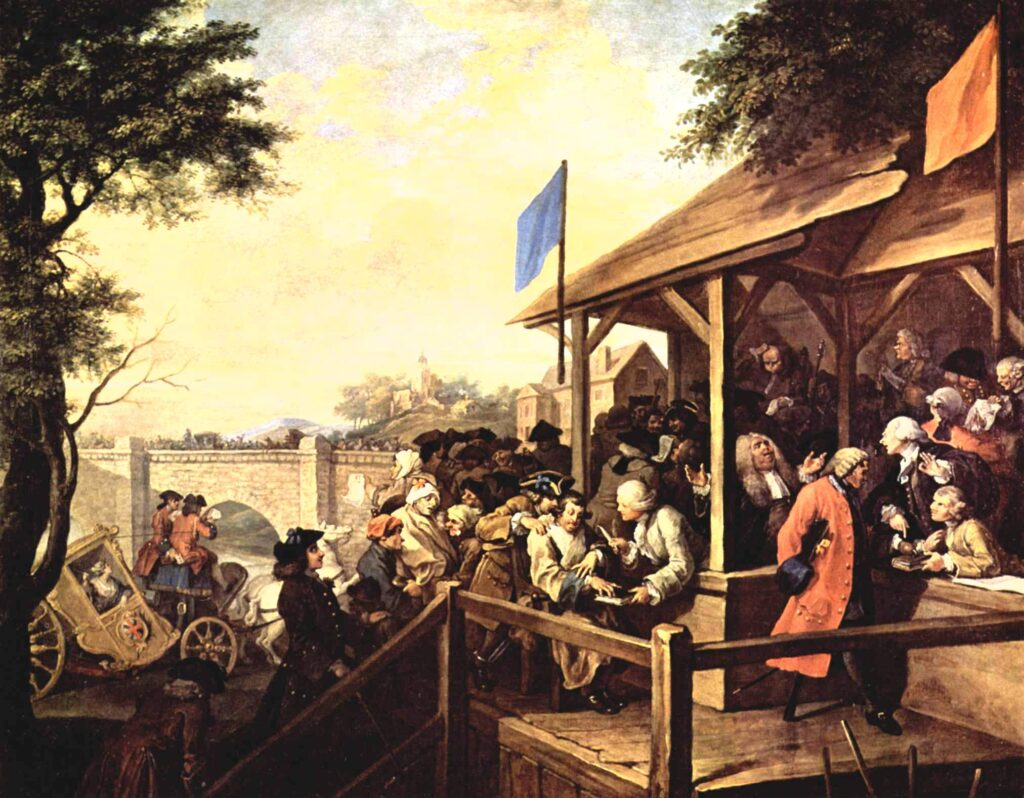
The Polling takes place on the day of the election and shows the polling booth, a rough wooden construction to which all the voters are coming to publicly cast their votes. In the background, it’s a beautiful, sunny spring day and the atmosphere is serene and peaceful. Unlike the foreground which is lively and chaotic.
The booth is decorated with two flags, the blue Tory flag on the left and the orange Whig flag on the right. The two candidates are sitting on chairs on either side slightly raised above the people around them. Between them a beadle or constable who is supposed to be controlling the election has fallen asleep. Neither candidate looks very confident.
On the left the Tory candidate is pushing back his wig and scratching his head. He is looking at a bundle of papers in his hand – the one on the top says ‘Bill’. He is clearly worried about the cost of his bribes but they seem to have been effective judging by the number of his supporters who have already voted and are now talking and drinking happily together.
On the right the Whig candidate is sitting upright and looking towards the bridge which is thronged with people on foot and horseback and in carriages, travelling in both directions, waving both blue and orange flags. Many are brandishing sticks and it is a scene of violence and chaos. The Whig candidate is probably hoping that some of them are coming to vote for him.
In fact, it may well be that the passage into town has been blocked to prevent electors from voting. Hogarth will have been aware of an incident that took place on Magdalen Bridge in Oxford during the 1754 election when a Tory mob of people surrounded a carriage belonging to a Whig and threatened to overturn it. A Captain Turton stopped the riot by shooting a Tory chimneysweep dead after which the crowd broke up.
In front of the Whig candidate is an artist wearing a red coat and a wig. He has produced an unflattering caricature of the candidate which is being viewed by two men who are amused by it.
In front of the polling booth there is a queue of electors arriving to vote who are in no fit state to exercise their judgment in this matter.
On the right of the painting is a smartly dressed ex-soldier in a red coat, carrying a tricorn hat with the Whig rosette on it wedged under his armpit. He has lost both arms and one leg fighting for his country and is taking the oath to swear that he is eligible to vote. However, he has no left hand, only a hook to lay on the bible and his legitimacy to vote is being questioned. Behind him two lawyers are arguing the case for each side. The one on the right, presumably representing the Tories, is pointing angrily to the hook believing it to be insufficient for swearing the oath. The one on the left, presumably representing the Whigs, is throwing up his hands in disagreement. Ironically, of all the electors queueing up to vote, the soldier is the most fit to choose between the Whigs and the Tories.
Behind the soldier is a man who has lost his reason and doesn’t know who he is voting for. He is being carried on a chair by a man whose legs are in chains because he is likely a prisoner out on parole. The criminal is wearing a blue Tory rosette in his hat and seems to be whispering the words of the oath in the ear of the man in the chair. The Tory recorder is leaning forward to hear him in order to register his vote. Barely visible in the shadow of the booth, there is an orange Whig rosette on the floor next to the fool’s feet, indicating that this was his preferred vote, had he been allowed to choose for himself.
Another Whig supporter, as indicated by the orange rosette on his head, is being carried to the poll by other Whig supporters. However, judging by the colour of his face, he appears to be dying, if he is not already dead.
The dying man is followed by a blind man, one hand on the shoulder of the young boy in front and carrying a cane. He is proudly wearing the blue Tory rosette on his hat but the Whigs have placed an orange rosette on his coat. The inference here is that he will not be able to vote as he wishes due to his disability. And at the back of the queue is a disabled Tory struggling to get up the stairs.
The four wooden sticks at the bottom of the picture on the right suggest that there are violent thugs ready to prevent people from voting for the ‘wrong’ party.
To the left of the polling booth is an elaborate coach, carrying Britannia clinging to a strap and clutching at the door. She is wearing flowing robes and there is a union flag on the door of the coach to symbolise the nation. The coach has completely broken down and even the white Hanoverian horses representing the monarchy cannot get it to move despite their struggling. The two coachmen, symbolic of the nation’s parliamentary leaders, are completely oblivious to the situation with the coach because they are busy playing cards. One of them is clearly cheating because he is hiding the three of clubs behind the other’s back.
Therefore, Hogarth is depicting the political state as corrupt, broken and beyond repair.
4. Chairing the Member
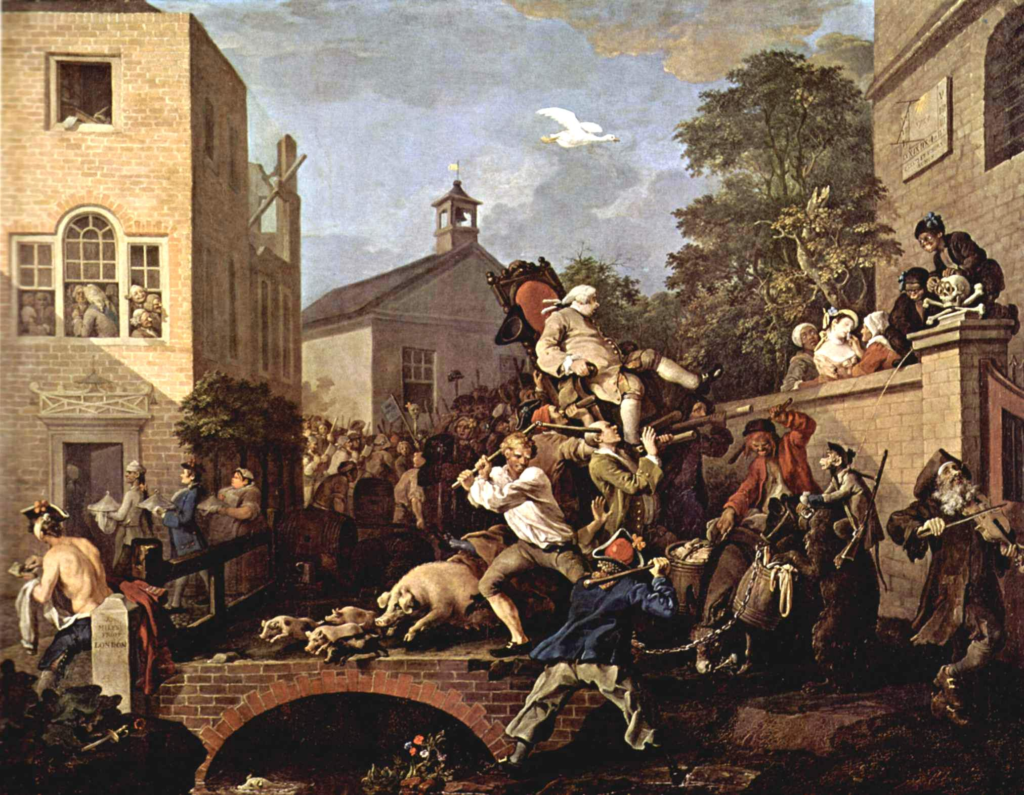
This scene demonstrates the practice of parading the two successful candidates around the town on elaborate chairs carried by their supporters. This was a familiar sight in the 18th century and took place along with feasting and celebration but was often accompanied by mob violence or protest if the candidates were unpopular or corrupt.
Hogarth portrays the chairing of the new Tory Member of Parliament in his imaginary town of ‘Guzzledown’ as a scene of catastrophe and utter chaos.
The setting is the main street of a small market town with three buildings set around the centre of the painting. Each building represents one of the three pillars of the state: the Church, local government and national government. On the right is the church, at the back is the town hall and on the left is the Whig Party’s headquarters. Each building is revealed to be corrupt in some way.
On the right the church is made of solid brick with a sundial on the wall showing the date ‘1755’. The church represents morality and convention. However, the graveyard’s consecrated ground has been desecrated by two young chimney sweeps, sporting blue Tory rosettes, who have taken a skull and crossbones and put them on the wall in front of the church to display them to the procession below. (Chimney sweeps were children who were sent up inside chimneys to sweep them clean. They got covered in soot from the chimney which is why the children in the picture have black faces.)
Their occupation is significant because it refers to the fatal shooting of a chimney sweep, Joseph Holloway, by a Captain Turton, during the 1754 Oxfordshire election. Turton, after a seven-hour trial, was found not guilty in just seven minutes. Hogarth’s depiction of the sweeps is a typical example of his work highlighting the injustice endemic in 18th century society.
In the central background is the town hall, a plain and unimposing building, reflecting local administration and government.
On the left is a red-brick building, still being built at the back, which is a bit of a mish-mash of architectural styles. There is a group of Whigs at the first floor window happily watching the proceedings and the Tory candidate’s imminent downfall. There’s a lawyer on the second floor sitting at a desk in front of some bookshelves drafting a legal document. Three servants are carrying in food for the Whigs to have a feast rather than commiserate with each other over their loss.
In the centre of the picture is one of the successful Tory candidates, being carried by four of his supporters, who is about to fall off the chair.
In front of the candidate two men are fighting. A sailor with a peg-leg, wearing Whig colours, is brandishing a club at a country labourer, stereotypically Irish according to his curly ginger hair, presumably a Tory supporter, who is swinging his threshing tool ready to attack the sailor but he has accidentally hit one of the chairmen on the head. The chairman stumbles causing the chair to topple. As the candidate falls, his finely dressed wife, watching the procession from behind the top of the church wall, faints and needs to be supported by her black maidservant while her old nursemaid tries to revive her with smelling salts.
Behind the brawling labourer, a sow and her piglets are charging towards the stream under the bridge, having just knocked over a countrywoman, her feet just visible over the sow’s back.
Apart from the toppling chair, the procession has been held up by an ass belonging to a butcher, who is a Scotsman judging by his red hair, carrying a load of offal. The ass has stopped to eat a thistle. A tame, muzzled dancing bear belonging to the sailor has also stopped, attracted by the offal. The bear and the monkey sitting on its shoulder are an act with which the sailor makes a living. The blue colours on the monkey’s hat suggest the show makes fun of the Tories. Incensed, one of the Tory chimney sweeps sitting on the church wall urinates onto the monkey.
The whole group is symbolically led by a blind fiddler who is clearly oblivious to the chaos and disorder behind him.
On the left of the painting is a brawny, shirtless soldier with a broken sword behind him. He is wearing an orange rosette in his hat and his head is wrapped in a bandage. The broken sword indicates that he has been fighting and he has stopped to roll some tobacco.
At the back of the picture the second candidate’s shadow is cast on the wall of the town hall. He is quite literally a shady character.
Between the two candidates is a crowd who have come to celebrate the Tory victory. On the left is an empty beer barrel into which a reveller has crawled to drink the dregs, while another full barrel is being carried by two workmen. Most of the crowd are Tory supporters but they are also carrying clubs and meat cleavers in preparation for violent disorder.
In Oxfordshire in 1754 the Tories won the election but the poll was so close that the returning officer sent all four candidates: two Tories and two Whigs to parliament. Parliament had to judge whether some of the votes cast in Oxfordshire were legal and in April 1755 – the year shown on the sundial on the church and during which the painting was completed – the Whig-dominated House of Commons declared the Whigs the legal winners.
The inscription on the sundial reads ‘PULVIS ET UMBRA SUMUS’ which means ‘We are but dust and shadows’. If the candidate for Guzzledown looks up, he will be reminded that his life and triumph is fleeting, as indeed was the Tories’ success in Oxfordshire.
Text











Leave a Reply