Click here to go straight to the exercises.
Sir John Soane’s Museum is in Lincoln’s Inn Fields behind Holborn Station. It was the home of Sir John Soane, an architect. He died in 1837 and it has remained almost unchanged ever since.
Soane’s early life
Sir John Soane was born in 1753 in Goring-on-Thames, near Reading. He was the youngest son of a bricklayer. By the age of 14, he had left school, his father had died, and he worked for his elder brother. At age 15 his talent for drawing was discovered. He was taken to London to become an apprentice to work for and be trained by George Dance the Younger.
At 18 he began to study architecture at the Royal Academy in the evenings. Six years later, he won a prize from the King which allowed him to do the Grand Tour, a trip around Europe usually only for the rich. He spent 2 years abroad, mainly in Italy, studying classical architecture and making useful contacts. When he returned from his tour, he set up his own business.
Family
In 1784 he married Eliza Smith. It was a love marriage but, luckily for Soane, Eliza inherited a large sum of money from her uncle. They had two sons: John Junior and George.
Work
In 1788, at the age of 35, Soane became architect to the Bank of England. This job lasted for 45 years. This job and his wife’s inheritance meant that Soane was able to buy number 12 Lincoln’s Inn Fields in 1792. He demolished the 17th century house on the site and built his own house.
Soane’s collection
Aged about 39, Soane began to collect and continued collecting until his death. He collected sculpture, paintings, architectural models, antiquities and architectural fragments. He intended to keep his collections at his country house, Pitzhanger Manor, for his son, John Junior: “… to make Pitzhanger Manor-house as complete as possible for the future residence of the Young Architect.” He sold Pitzhanger Manor in 1809 when it became clear that John Junior, now aged 23, showed “neither talent nor inclination” to become an architect. He moved his collections back to Lincoln’s Inn Fields, but not to number 12…
The Museum
In 1808, 14 years after the family moved to number 12, Soane bought number 13 Lincoln’s Inn Fields, next door. First, he demolished the stable block at the back and built a museum for his collection. Underneath this area he built a crypt. This looked a bit empty to Soane so he bought an ancient Egyptian sarcophagus, 35,000 years old, after the British Museum refused the price of £2,000. It was so large he had to knock down the back wall to get it in. This was his most prized possession. Soane was so proud of this that he held three evening parties to celebrate and invited nearly a thousand people.
But there still wasn’t enough room for his collections…
By 1813, number 13 had been demolished and rebuilt and Mr and Mrs Soane moved in. So did his collections. He filled the dining room and the adjoining library, the study, the breakfast room – only the drawing rooms stayed fairly empty, and Mrs Soane might have had something to do with this. But there still wasn’t enough room for his collection…
In 1823, Soane bought number 14 Lincoln’s Inn Fields, the third in his row of houses. He rented out the main house here but behind it he built a picture room with the walls open to make more space for all his pictures, and underneath that he built a Monk’s Parlour.
Death
The room was created after the death of Soane’s wife in 1815 and eldest son, John Junior, in 1823. The room was designed to look dark and gloomy and symbolises Soane’s grief and loneliness. The one remaining link to his wife was Fanny the dog but she died as well on Christmas Day 1820. In the Monk’s Yard outside the room, you can see the epitaph: “Alas, Poor Fanny” on the grave where the dog is buried.
Self-importance
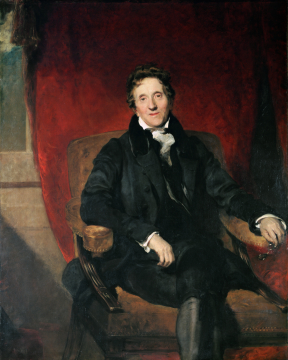
In 1828, Soane had a portrait and a bust made of himself. They are placed at points to make him visible in many areas of the Museum. Soane was knighted in 1831, when he was 78 years old.
What about Soane’s family?
Soane’s eldest son, John Junior, married and had four children. His youngest son, George, wrote romantic novels – Soane called it “dramatic writing”. George married and had four children by his wife and also one by his wife’s sister. He often ran up serious debts and asked his father to bail him out. In 1815, Soane finally refused to rescue him and George spent several weeks in debtor’s prison. On his release, he wrote two newspaper articles attacking his father’s architecture. Mrs Soane was very upset and claimed: “George has given me my death blow, I shall never hold up my head again.” She died two months later, actually from gall stones. John Soane believed George was to blame for causing “the death of all that was dear” and cut him out of his life, although he still paid a small allowance to his wife and family. John Junior had bouts of severe ill health and died in 1823, aged 38.
Why has the house/museum remained the same since 1837, when Sir John Soane died?
Soane’s wife died in 1815, 22 years before him, and his eldest son, John Junior, 14 years before him. He was estranged from his youngest son, George. Who could he leave his house and collection to?
In 1833, Sir John Soane made an Act of Parliament, leaving his house and collection to the Nation, on two conditions:
- The Museum must be kept “as nearly as circumstances will admit” in the state in which it was left at the time of Soane’s death in 1837.
- There must be free access for students and the public to “consult, inspect and benefit” from the collections.
That is why the Museum still looks very similar today to how it did in 1837. Number 12 was also left to the Nation to rent out for the upkeep of the Museum. Sir John Soane left Number 14 to descendants of his eldest son. To his youngest son, George, he left one thing: a framed copy of George’s article with “the death blows” written underneath.
Family tomb
The family tomb is in Old St Pancras Churchyard. Look carefully at the domed top. What does it remind you of? In fact, the domed tomb was the inspiration for Sir Giles Gilbert Scott’s famous K2 telephone box of 1924-26.
Thanks to Sir John Soane, we can visit the museum for free today and find it much as he left it in 1837.
Transcript with pictures
Exercises
Answers
Back to top











Leave a Reply