Click here to go straight to exercises.
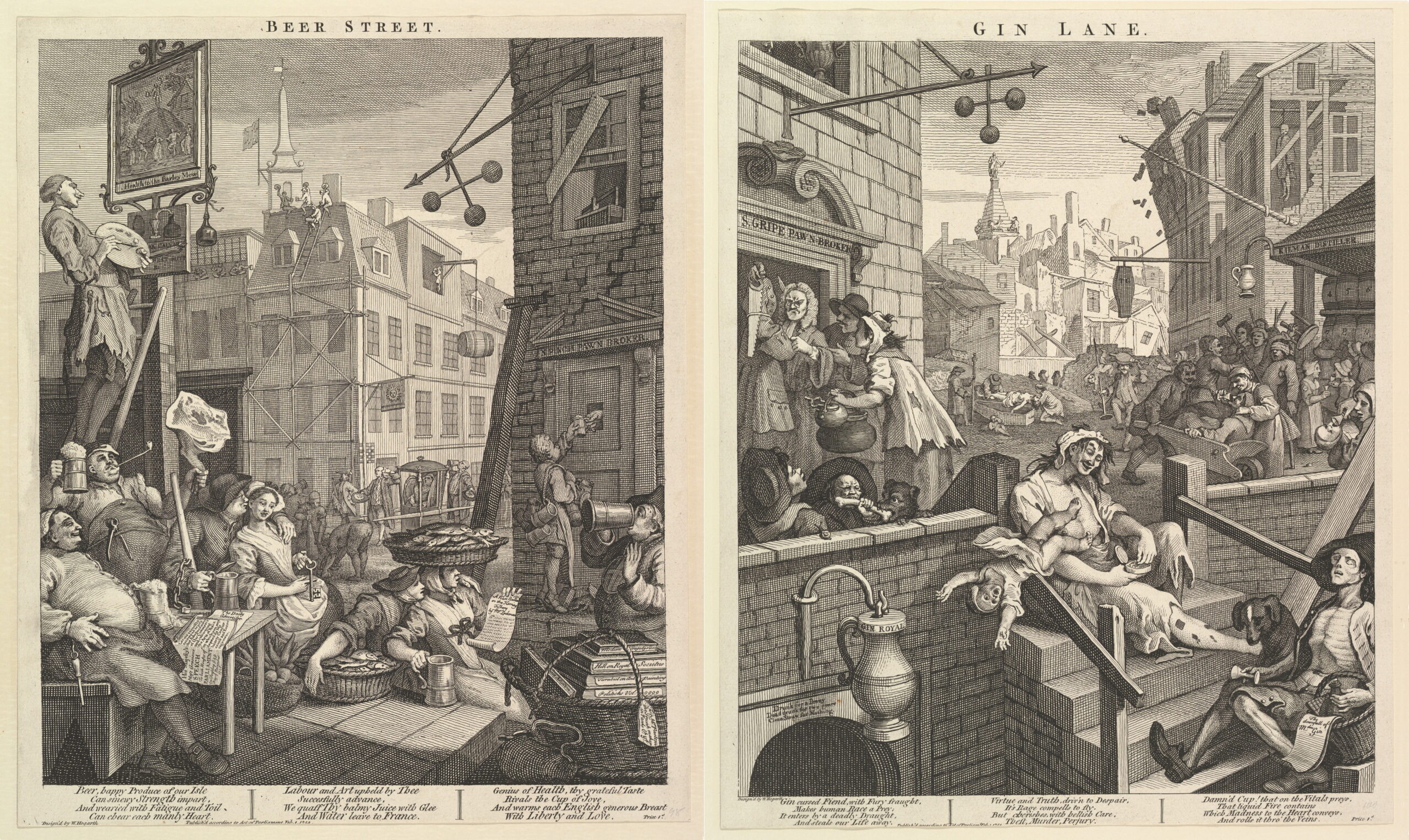
Beer Street and Gin Lane are two prints issued in 1751 by English artist William Hogarth. They are designed to be viewed together as they depict the evils of the consumption of gin in contrast to the merits of drinking beer.
The Gin Craze
Hogarth lived and worked during the Georgian era when alcohol was commonly drunk by all classes. The increasing consumption of gin from the 1700s resulted in an epidemic of binge drinking that became known as the ‘Gin Craze’, which was especially problematic in London.
From 1689 onward the English government encouraged the industry of distilling as it helped increase grain prices which were low at that time. Imports of French wine and spirits were banned to encourage the industry at home.
As gin was cheap, it was consumed especially by the poor. It was a way to forget hunger and poverty and it was often safer to drink than the city’s contaminated, sewage-infested water. In St Giles-in-the-Fields, a slum area of London, north of Covent Garden, one in five households sold gin whereas in Westminster the ratio was one in fifteen.
However, because there was no quality control and production was unregulated, gin was often distilled illegally in people’s homes and frequently mixed with harmful substances such as turpentine, sulphuric acid and lime oil. As a result, there were enormous health and social problems including violence, criminality, infant mortality, insanity and often death.
By 1730, it is estimated that there were around 7,000 gin shops in London. Signs above gin bars read: “Drunk for a penny; dead drunk for two pennies; clean straw for nothing”.
Gin Lane
Concerned citizens started a campaign which resulted in the Gin Act of 1751, passed to reduce the uncontrolled production and sale of cheap gin. Hogarth produced these prints to aid the campaign. He made the plates himself to reduce the cost so they could be sold more cheaply to reach more people.
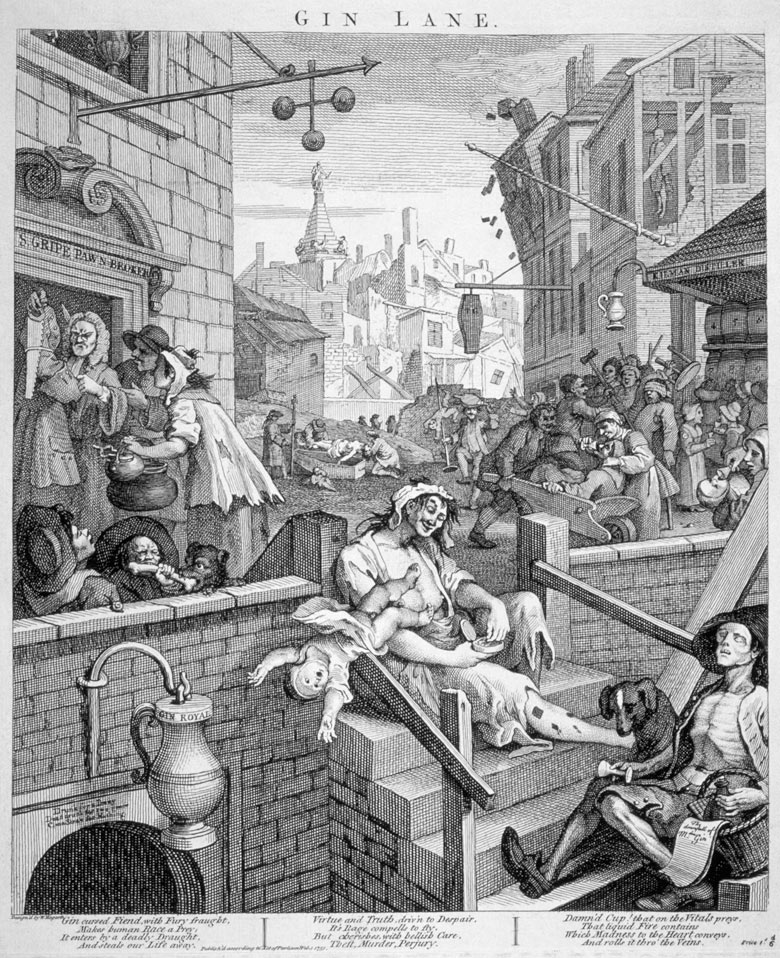
The scene is St Giles, a notorious slum in London, which depicts the squalor and despair of a community raised on gin. The only businesses doing well are the gin sellers, the distiller (aptly named Kilman), the pawnbroker, and the undertaker.
The focus of the picture is the woman in the centre who is drunk on gin and has let her baby slip from her arms and plunge to its death in the stairwell of the gin cellar below. Her breasts are exposed and she is focused only on taking snuff from a box. She has been driven to prostitution and has syphilis as shown by the sores on her legs. It is a shocking image but Hogarth would have been aware of the case of Judith Dufour in 1734. Her two-year-old child had been placed in the workhouse where it had been given clothing and looked after. Dufour reclaimed her child, strangled it, and left the body in a ditch so that she could sell the clothes for one shilling, four pence and buy gin.
In another case, an elderly woman, Mary Estwick, let a toddler burn to death while she slept in a gin-induced stupor.
The image of the neglectful mother became increasingly central to anti-gin propaganda.
Other images of despair and madness fill the scene. A disturbed man is beating himself over the head with a pair of bellows while holding a baby impaled on a spike. The child’s mother is rushing from the house screaming in horror.
A barber has committed suicide in the dilapidated attic of his barber shop, ruined because nobody can afford a haircut or a shave.
On the steps below the drunk woman, is a pamphlet seller who is little more than a skeleton, perhaps due to starvation. His unsold pamphlet The Downfall of Mrs Gin warns of the evils of gin-drinking. He is an ex-soldier who has pawned most of his clothes to buy the gin in his basket. A black dog is sitting next to him – a symbol of despair and depression.
Outside the distiller, a fight has broken out and a disabled man is threatening to hit a blind man with his crutch.
An old woman in a wheelbarrow is being fed gin, another woman on the right of the picture is feeding gin to her baby and two young girls behind her are drinking gin.
In the background a naked baby has been left crying on the ground while its dead mother is being loaded into a coffin on the orders of the beadle. (A beadle was an officer of the parish.)
At the pawnbrokers on the left, the greedy Mr Gripe takes the vital possessions from a carpenter and his wife. The carpenter pawns his saw and his wife her cooking pots in order to get some money to buy gin.
In front of them a starving boy and a dog fight over a bone, while next to them a boy has fallen asleep and a snail is approaching, a symbol of the sin of laziness.
In the background the buildings are falling down, representing the breakdown of society. St George’s Church, Bloomsbury, can be seen in the distance but Hogarth has composed the picture so that the pawnbroker’s sign forms an alternative cross for the steeple on top of the church. The people of Gin Lane worship elsewhere.
Beer Street
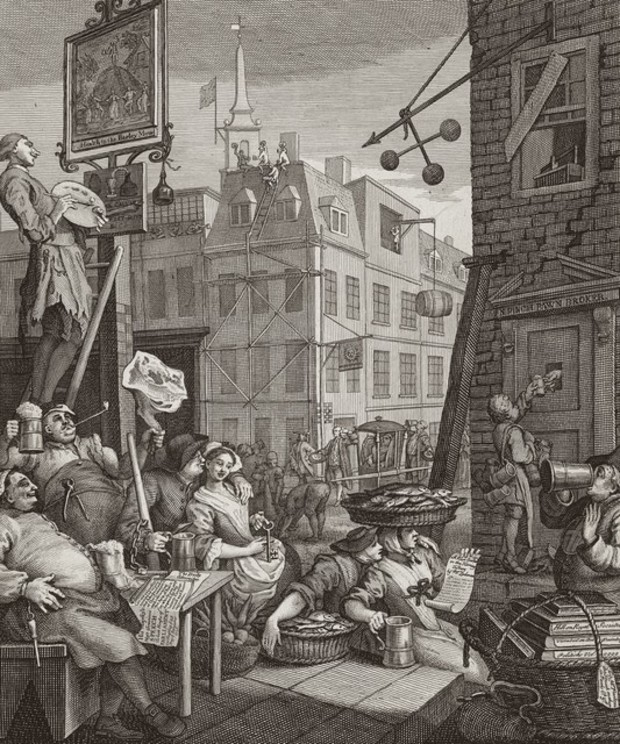
In contrast to the hell that is Gin Lane, Beer Street is full of happy, productive people enjoying life. The only failing business is the pawnbrokers, run by Mr Pinch. His building is run down and the sign is hanging off the wall. People here do not need to pawn off their belongings as they are relatively prosperous. The pawnbroker has to have his beer delivered through a small window in the door, perhaps because he is afraid of debt collectors coming after him.
The other buildings in the picture are well-maintained and the church steeple on the top is a sign that people behave morally here.
It is George II’s birthday, 30 October, as indicated by the flag flying on the church of St-Martin-in-the Fields in the background, so maybe the inhabitants are toasting his health. The King’s speech displayed on the table refers to the “Advancement of Our Commerce and the cultivating Art of Peace”. It is clear that the inhabitants of Beer Street are all working in commerce, unlike the majority of the inhabitants of Gin Lane who are drunk and incapable of work.
The sign of the Barley Mow inn shows people dancing happily around a mountain of barley (barley being an ingredient of beer). Under the sign sits a blacksmith or cooper (someone who makes beer barrels), holding a foaming tankard of beer in one hand and a leg of meat in the other. Next to him is a butcher, holding his steel for sharpening knives, also enjoying a tankard of beer.
In front of them is a paver (someone who repairs the street), like the men in the centre of the picture, and a housemaid he is courting. She is holding a key which is a symbol of home or family life.
Near them is a pair of fish-sellers resting with a pint of beer. They are singing the New Ballad on the Herring Fishery, which was written by Hogarth’s friend, the poet John Lockman. Their baskets are overflowing with fish which represents the success of the fishing industry.
On the right is a porter who has set down his basket of books to enjoy a beer also. Tied up in the basket are examples of books, real and imagined, that Hogarth disapproved of. The books are destined for the scrap heap.
In the background, two men carrying a sedan chair stop for a drink. Inside the sedan chair is a wealthy woman wearing a large hoop skirt which prevents her from getting out of the chair. She can be compared with the woman in the coffin and the woman in the wheelbarrow in Gin Lane. The rich woman is a prisoner due to her fashionable but impractical dress, while the women in Gin Lane are prisoners due to their poverty and addiction to gin.
On the roof, the builders who are working on the publican’s house above The Sun inn, share a toast with the master of a tailor’s workshop next door. In this picture, a barrel of beer is hanging from a rope, in contrast to Gin Lane where it is the body of the barber.
Apart from the master tailor, the other tailors have not stopped working in the attic. The wages of journeyman tailors were the subject of an ongoing dispute, which was finally settled in their favour by arbitration in 1751. Hogarth shows them continuing to work while most of the other inhabitants of the street have taken a break for refreshment.
However, although the workers have paused for a break, it is clear that they are not idle. The builders have not left their workplace to drink; the master tailor toasts them from his window but does not leave the attic; the men in the foreground still have their tools with them and the fish-sellers and the man with the basket still have their goods to hand.
That just leaves the sign-painter who is a bit of an enigma. He is dressed in ragged clothes and is quite skinny compared to the rather well-fed workers enjoying their beers. However, he is painting an advertisement for gin below the sign for the Barley Mow inn, which is associated with beer. His ragged clothes may reflect the rejection of gin by the people of Beer Street. He may also be a resident of Gin Lane and Hogarth has included him as a connection to that scene.
The government’s initial policy of encouraging the distillation of gin may be the cause of both Gin Lane’s ruin and Beer Street’s prosperity. The sign-painter is ignored by the people of Beer Street as they ignore the misery of Gin Lane itself. It is also possible that Hogarth is making a statement about the artist’s status in society as the sign-painter is carrying an artist’s palette, just as Hogarth includes an artist’s palette in his self-portraits.
Beer Street is a counterpoint to the more shocking Gin Lane. It is a celebration of Englishness and depicts the benefits of being nourished by the native beer. No foreign influences contaminate what is a strongly nationalistic image.
You might wonder how beer can be promoted as a health-giving elixir for life. It has a lower alcohol content than gin and was safer to drink than the water, given that it had gone through the fermentation process. Water at that time was highly polluted with sewage and there were numerous epidemics of water-borne diseases such as cholera. In addition, gin was often contaminated with poisonous substances which were added to make it even cheaper for the poor to afford.
Hogarth intended Beer Street to be viewed first to make Gin Lane more shocking. The middle classes would have seen the pictures as a comparison between good and evil. The working classes would have seen the connection between the prosperity of Beer Street and the poverty of Gin Lane. The free-market economy supported by the King’s speech and practised in Beer Street leaves the exponents prosperous and well-fed but at the same time makes the poor poorer.











Leave a Reply