Click here to go straight to the exercises.
A Rake’s Progress
1. The Heir
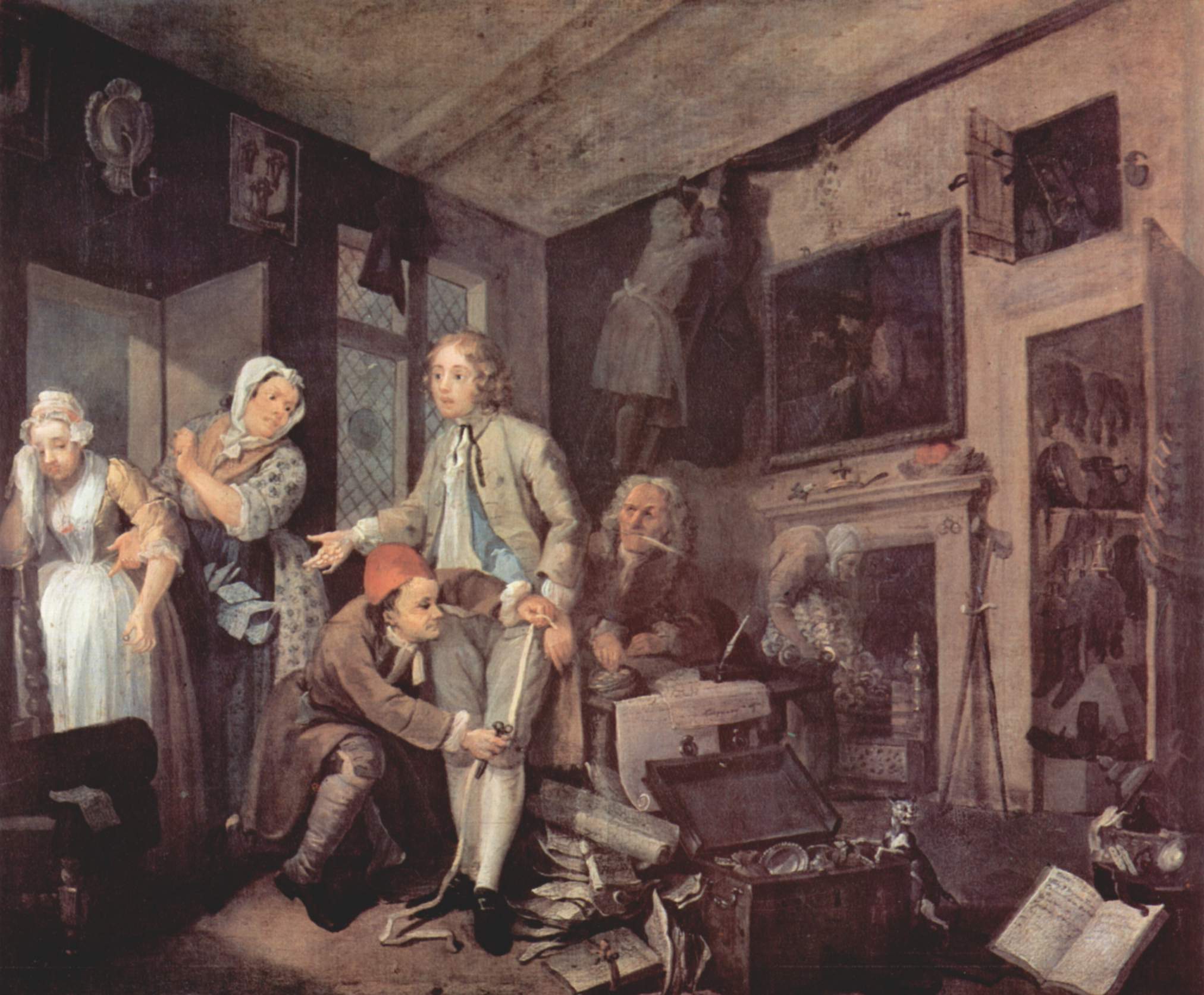
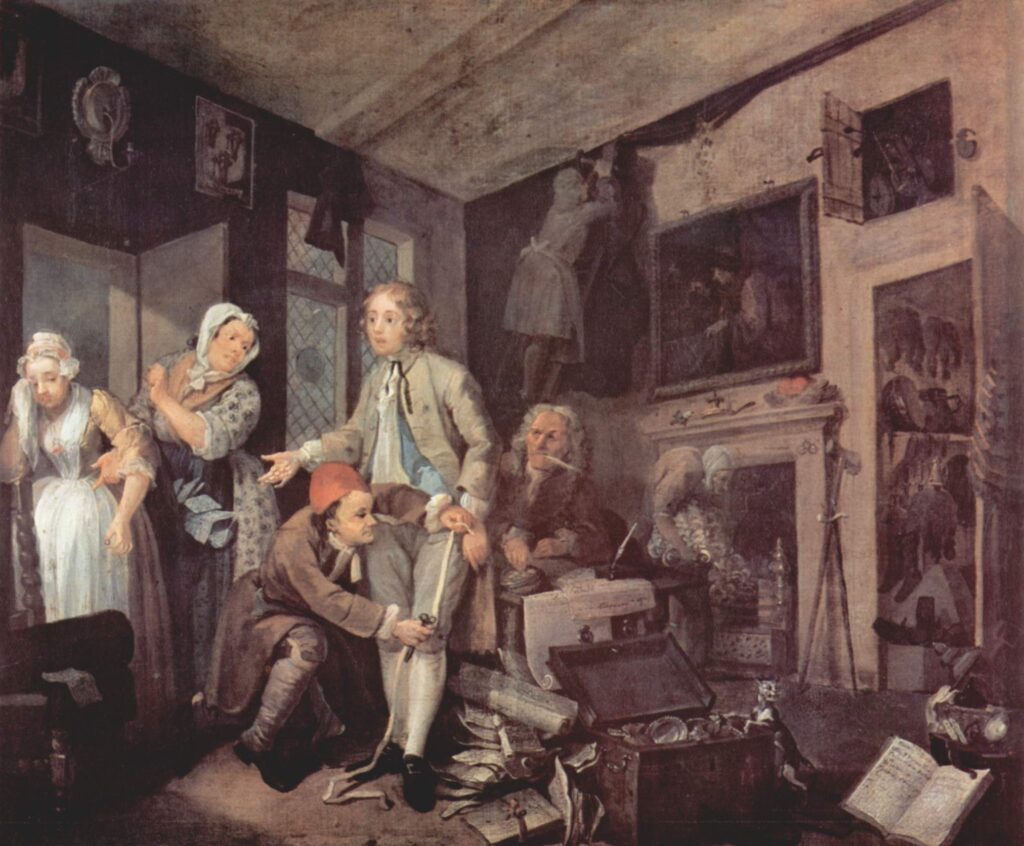
Tom Rakewell is the protagonist of the story. His father, a miserly financier, has just died and Tom has inherited his fortune. Tom is in his father’s house being measured for new clothes. The house is unkempt and gloomy. His father’s wealth has been hidden away and the servants are finding treasure in the fireplace and walls. Behind Tom, a lawyer, employed to compile an inventory of his dead father’s estate, is stealing gold coins. A starved cat searches for food in a chest full of silver. Sarah Young, a servant girl and Tom’s fiancée, stands weeping at the door, holding a wedding ring in her hand. Tom tries to pay her off with gold coins but these are angrily rejected by Sarah’s mother who points out to Tom that he has got Sarah pregnant.
2. The levée
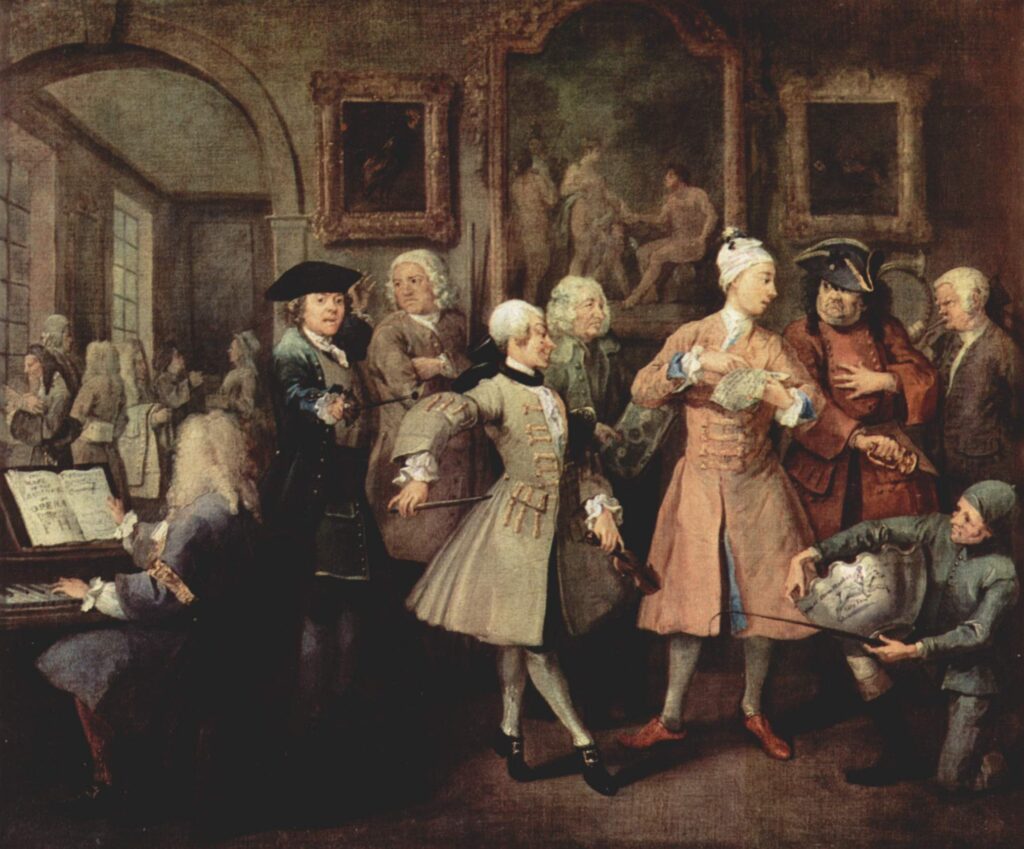
Tom is in his new palatial lodgings where he is holding a morning levée in the manner of a fashionable gentleman. A levée is an audience with visitors and tradespeople hoping to be employed, while the aristocrat prepares for the day. The hangers-on are all dressed in expensive costumes. Surrounding Tom from left to right are: a music master at a harpsichord, who was supposed to represent George Frideric Handel (Hogarth’s great rival); a fencing master; a quarterstaff instructor (stick fighting); a dancing master with a violin; a landscape architect; an ex-soldier offering to be a bodyguard and a bugler of a fox hunt club. At the bottom right is a jockey with a silver trophy which reads: “Silly Tom”. The instructor looks disapprovingly on both the fencing and dancing masters. Both masters appear to be in the “French” style, which was a subject Hogarth loathed.
The crowd of people vying for Tom’s attention, including those in the adjoining room, is meant to appear absurd, satirising both the taste and entertainments associated with high society and those members of the middle class who, like Tom, indiscriminately aspire to it. Indeed, Tom’s lack of judgement and pursuit of pleasure will be his undoing. There is an indication of this in one of the paintings on the wall: The Judgement of Paris – a story of bad choices and downfall. There are three Italian paintings on the wall which Tom has recently acquired. Hogarth was known to dislike the fashion for acquiring Old Master works (which he branded “dark pictures”) at the expense of paintings by British artists.
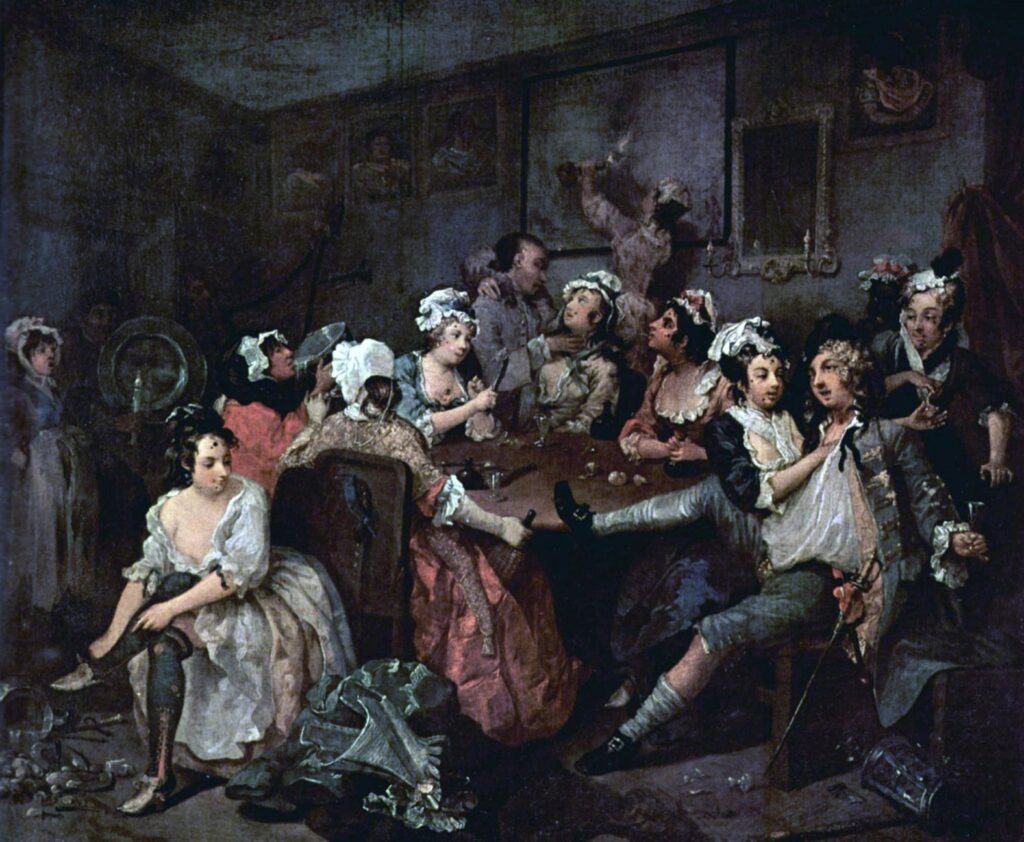
3. The Orgy
It is three o’clock in the morning and Tom, drunk, is enjoying the attentions of prostitutes at the Rose Tavern in London’s Covent Garden. A night watchman’s staff (stick) and lantern lie beside him (souvenirs of a rowdy night in the surrounding streets). Two of the ladies are relieving Tom of his watch. In the foreground, a prostitute/stripper is undressing ready to spin and pose on the pewter dish that is being carried into the chamber by a waiter. By her foot, a chamber pot has spilt on some food and there is broken glass everywhere. Near the doorway on the left, next to the waiter with the large pewter dish, a street singer performs a bawdy song. The prostitutes have black spots on their faces to cover syphilitic sores.
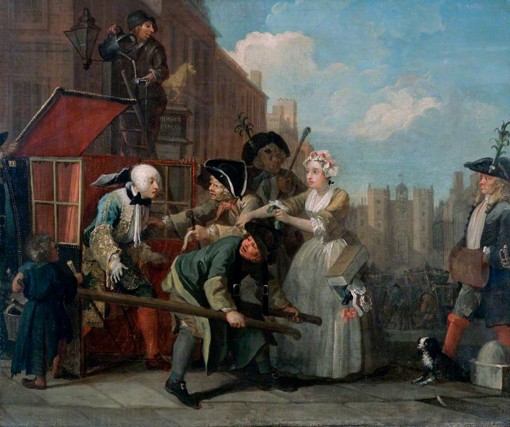
4. The Arrest
Tom is in a sedan chair on his way to St James’s Palace to be presented at court. It is Queen Caroline’s birthday and St David’s Day (Saint David is the patron saint of Wales). The bailiffs wear leeks in their hats to mark the occasion. Unfortunately, he has been stopped by a bailiff who is about to arrest him for debt as he has spent all his inheritance on the pursuit of pleasure. He was hoping to meet a patron to rescue him at the Palace. Fortunately, he is saved by the intervention of Sarah Young, the girl he had earlier rejected. She is now a milliner and pays his bail money with her meagre earnings. This demonstrates her generous spirit and enduring, if misplaced, love for him. A street urchin steals Tom’s gold-topped cane, whilst a lamplighter, distracted by the commotion, accidentally pours oil on to Tom’s wig. This is a sly reference to how blessings on a person were accompanied by oil poured on the head. In this case the “blessing” being the “saving” of Tom by Sarah, although Rakewell, being a rake, will not take the moral lesson to heart.
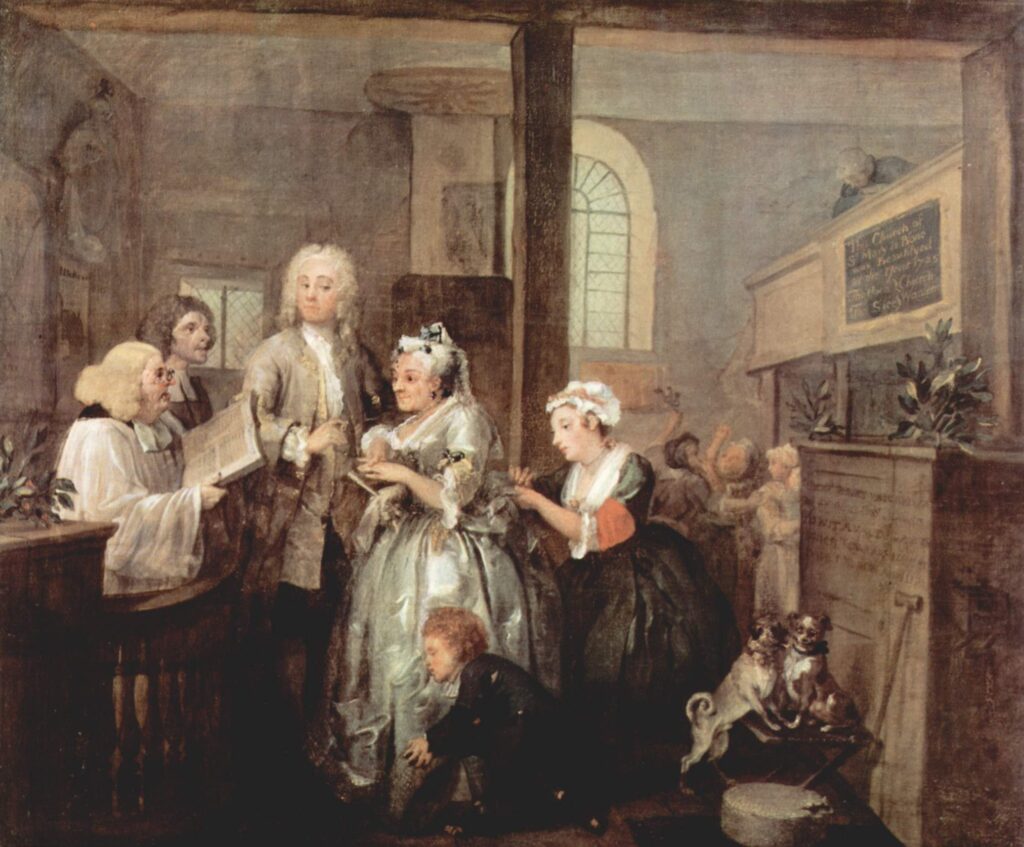
5. The Marriage
The scene is set in Marylebone Old Church, which at this time was on the northern fringes of London and well known as a venue for clandestine weddings. The church is dilapidated. Having squandered his fortune, Tom attempts to appropriate another one, not through gainful employment, of course, but marriage. Having rejected marriage with the young, pretty and faithful Sarah, Tom’s bride is now an ageing, dumpy, one-eyed heiress. The law gave a husband complete control over his wife’s property. During the ceremony Tom eyes up the spinster’s maid but ignores Sarah, their son and Sarah’s mother who are trying to get into the church to stop the ceremony. Sarah’s attempt to interrupt this shameful ceremony is prevented by a brawl between her mother and an overzealous church attendant. In the foreground, two dogs (one of which has lost an eye) present a grotesque parody of the marriage.
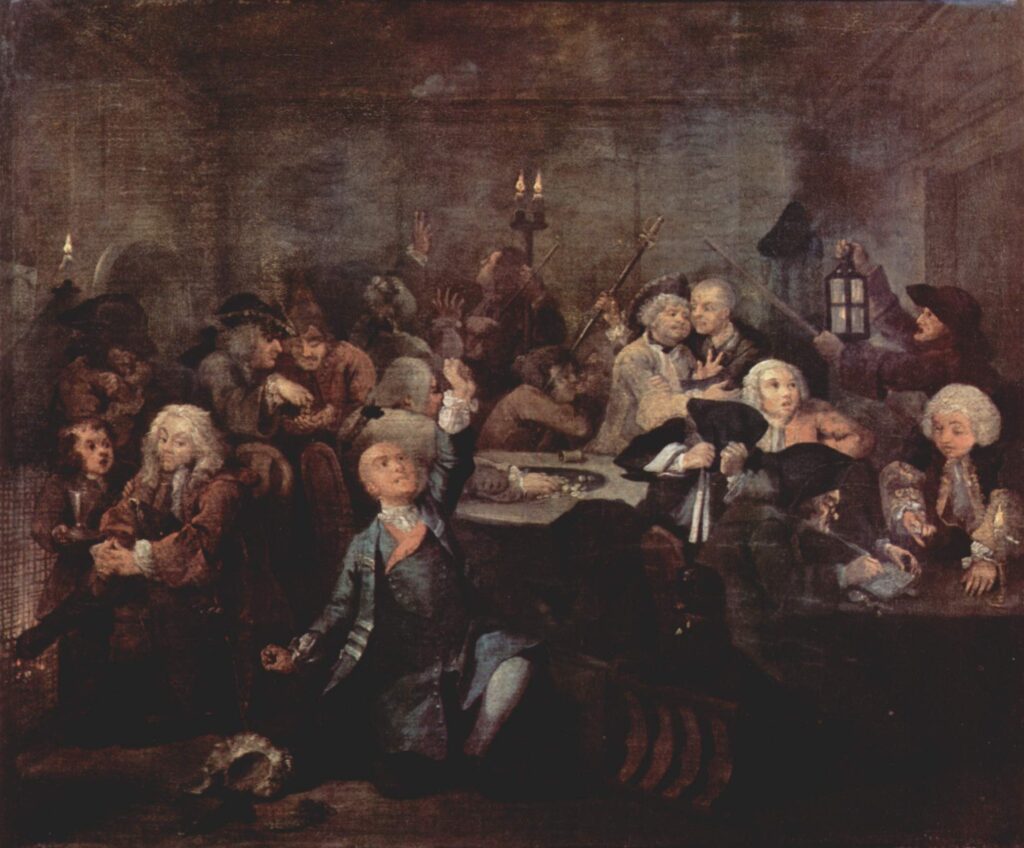
6. The Gaming House
The setting is a dingy gambling den at White’s Club in Soho. Tom, on his knees, wigless and cursing his fate, has gambled away his second fortune. Tom is not the only loser. A number of fortunes are changing hands underlined by the reactions of the men around the card-table in the centre. A dejected highwayman (with pistol and mask protruding from his pocket) sits by the fire and a nobleman, eager to continue playing, pleads for an advance from a moneylender. The obsessed gamblers are oblivious to the fact that the club is on the point of destruction by fire. Only the two croupiers appear to have noticed the smoke curling in from behind the panelling.
7. The Prison
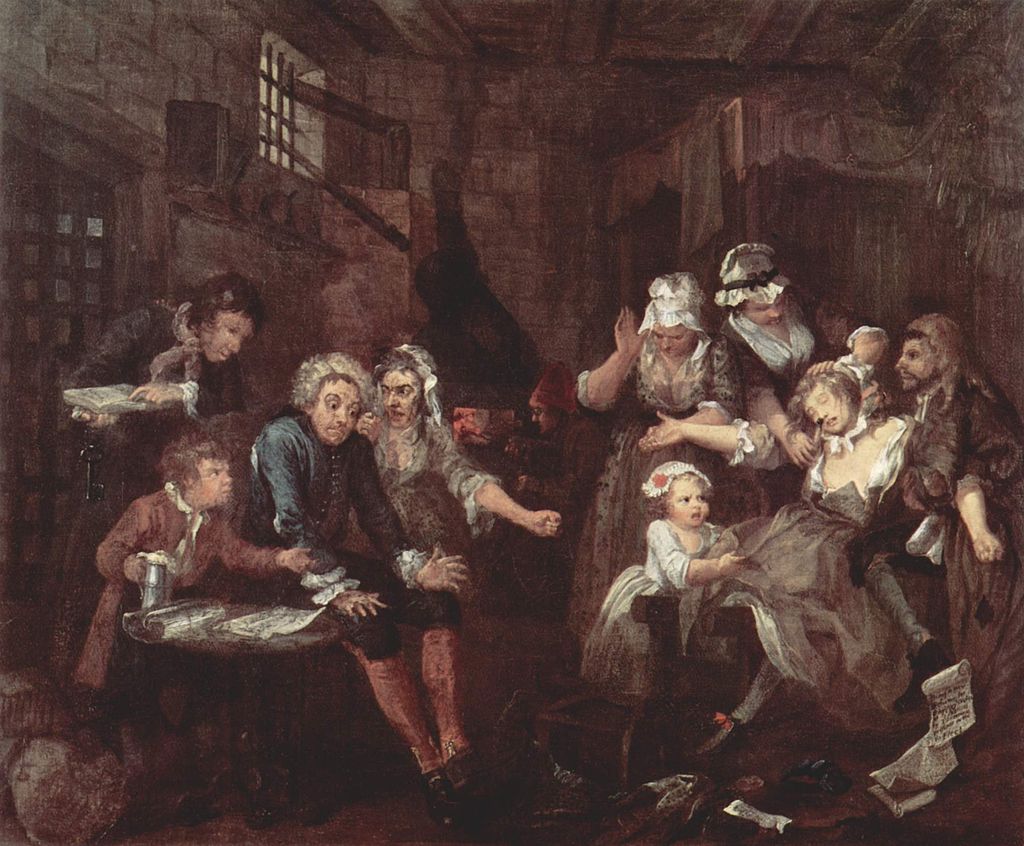
Tom is now incarcerated in the notorious Fleet debtor’s prison. His previously plump wife, standing to his left, is now emaciated, indicating their desperate circumstances. She scolds him for having squandered her fortune. In order to raise some cash to secure his freedom, Tom has written a play, which lies rolled on the table next to him. The play has been rejected and Tom is unable to pay his fees to the gaoler who is demanding settlement of his weekly bill by pointing at a ledger. The beer boy also harasses him for payment. Other prisoners in the cell are trying similarly hopeless schemes to raise money or escape. One man has written a treatise on how to pay “ye Debts of ye Nation” and an alchemist seated at the back has a madcap scheme to make base metal into gold – “fool’s” gold. Above the bed at the right is an apparatus for wings. A telescope for celestial observation is poking out of the barred window. Tom is exhibiting the first signs of impending madness and has sunk into despair. With no course of action left to him, he has gone into a paralytic stupor. Sarah Young, who is visiting with her child, has fainted from distress at the scene.
8. The Madhouse
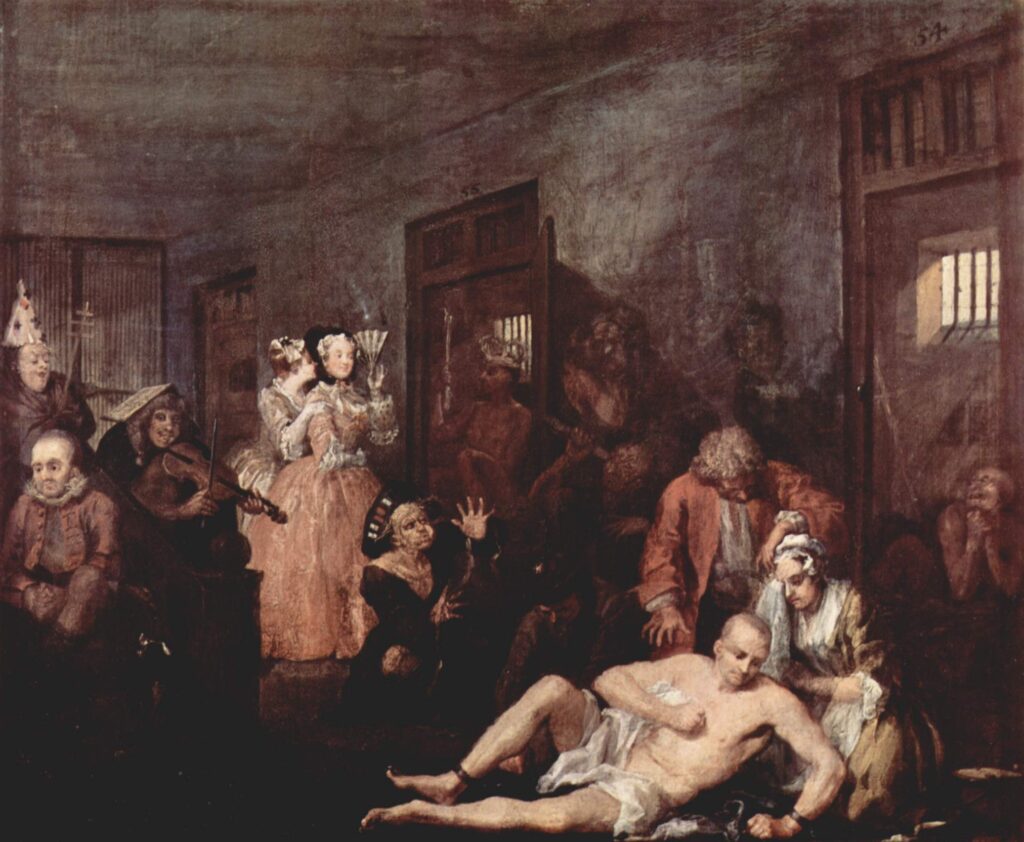
Tom, insane and violent, is now in Bethlehem Royal Hospital or Bedlam as it was known, an asylum for the poor and insane. He is lying in the foreground almost stripped of clothes and thus his social pretensions. Only Sarah Young is there to comfort him, but Tom continues to ignore her, despite her weeping. He is surrounded by other inmates who are suffering various delusions. These include a tailor, a musician, an astronomer and an archbishop. In the door to one of the cells is a man who thinks he is a king – he is naked and carries a straw crown and sceptre. Like prisons and other hospitals, Bedlam was open to paying visitors. Within this scene a fashionably dressed aristocratic lady and her maid are standing towards the left, amused and disgusted by the bizarre antics of the poor suffering lunatics around them. They have come to the asylum as a social occasion to be entertained. The irony is that, while Tom had set out to mimic the aristocratic lifestyle, he finishes by being one of its entertainments.
Text
Exercises
Answers
Back to top











Leave a Reply