Click here to go straight to exercises
Early Life
Vincent van Gogh was born on 30 March 1853 in Brabant in the Netherlands. He was the first of six surviving children.
His mother, Anna, was a nature-lover and amateur artist who drew plants and flowers. His father, Theodorus, was a pastor of the Dutch Reformed Church.
Vincent was very close to his brother, Theo, who was four years younger than him. It was Theo who supported Vincent financially throughout all the difficult years when Vincent was struggling to make it as an artist. Vincent and Theo wrote hundreds of letters to each other over the years and these have given us a lot of information about Vincent’s life.
Work
In 1869, when Vincent was 16, he went to work for Goupil and Cie, a French firm of art dealers. His Uncle Vincent was a partner in the firm. He was employed by them for the next seven years, first in The Hague and later in London and Paris. He drew a lot and educated himself in art history. He became proficient in the English and French languages and learnt about English and French literature.
Vincent started off well working in The Hague but by the time he got to London he had become disillusioned with the art business and started arguing with the customers about art. Once he got to Paris, he became much more interested in religion and was finally dismissed from Goupil in March 1876.
From 1876 to 1880, Vincent taught at English boarding schools, worked in a Dutch bookshop and tried to become a minister. However, he failed his theological exams and moved to the Borinage region in Belgium where he worked as a lay minister to oppressed coal-mine workers.
Becoming an artist
Finally, in August 1880, at Theo’s suggestion, Vincent decided to become an artist. He had a natural gift for drawing and in November 1881 he moved to The Hague to study. This is where he created his first paintings.
Personal Life
Before he arrived in The Hague, Vincent had met a recently widowed cousin, Cornelia ‘Kee’ Vos Stricker, at his parents’ house, the parsonage, in the town of Etten. She was seven years older than him. He fell in love with her but she rejected him. This seems to have brought on his first serious bout of depression.
Whilst in The Hague, in January 1882, Vincent met Clasina Maria ‘Sien’ Hoornik. She was an artist’s model and a prostitute, had a small child and was pregnant with a second. They moved in together and Sien gave up prostitution for a while. However, this could not last as they were all dependant on Theo’s financial support which was not enough. Their relationship ended when Vincent left The Hague in September 1883.
He moved back to his parents’ home in December. They had recently moved to a town called Nuenen. Vincent’s relationship with his father was tense and he described his father as ‘narrow-minded’ in a letter to his brother, Theo, who was now working for Goupil in Paris.
Developing as an artist
While in Nuenen, Vincent painted local peasants and weavers. One of his most famous paintings from this time is The Potato Eaters.
In March 1885, Vincent’s father died of a stroke. In November, Vincent moved to Antwerp and it was here that he began to collect Japanese prints, which were to have a strong influence on his art.
Paris
In 1886 he joined his brother, Theo, in Paris. Theo was now a director of a small art gallery in Montmartre. In June they moved to Rue Lepic on top of the hill, with a panoramic view of the city and with three remaining windmills which reminded the brothers of their native Holland.
Vincent continued to study art and met many other artists. The two years he spent in Paris were transformational. He learnt about the latest trends in French art and attended the eighth and final Impressionist exhibition, held in May-June 1886. The exhibition included work by Edgar Degas, Berthe Morisot, Mary Cassatt, Paul Gauguin and Georges Seurat.
Vincent visited the Montmartre art supply shop and picture gallery of Julien ‘Père’ Tanguy. He greatly admired Tanguy, who was a political radical and a supporter of avant-garde artists. When Vincent painted his portrait, he depicted him against a background of Japanese prints.
Another spot in Montmartre frequented by artists was the Café du Tambourin. Vincent painted a portrait of the owner, Agostina Segatori, seated in the café drinking beer, at a time when the Japanese print collection of Vincent and Theo was displayed on the café’s walls.
Arles
In 1888, after two years in Paris, Vincent was feeling stressed and went to live in Arles in the south of France, where he stayed for fifteen months.
He lived for a while at the Café de la Gare which was run by Joseph Ginoux and his wife Marie. However, he dreamt of setting up an artists’ colony at the Yellow House.
On 30 May he left the town for five days and stayed in the coastal fishing village of Saintes-Maries-de-la-Mer. Here he drew and painted the beach, the sea and the town. This was his first view of the Mediterranean.
June was harvest time and Vincent headed to La Crau where he painted the wheatfields. He also painted The Sower, a landscape of a setting sun over a wheatfield, incorporating a figure inspired by the artist Jean-François Millet.
Back in Arles, Vincent had difficulty persuading peasants to model for him. Unexpectedly, a Zouave – a soldier indigenous to North Africa – turned up at his studio. Fortunately, he was happy to pose in the uniform of his French army regiment. The soldier also liked drawing and he and Vincent went to the countryside to sketch together.
Once the weather became too hot, Vincent worked inside painting still-lifes, for example, Oleanders. He painted sunflowers with the purpose of decorating the Yellow House.
In early September, while he was still living at the Café de la Gare, Vincent painted The Night Café. The café remained open all night with customers from the margins of society. He wrote to his brother, Theo: “It was what they call here a night café… night prowlers can find a refuge here if they are unable to pay for a bed or if they are too drunk to be allowed anywhere. In my picture… I have tried to express the idea that the café is a place where one can ruin oneself, go mad or commit crimes.”
At around the same time, Vincent painted Café Terrace at Night, where he first painted the night sky of Provence. Later, he painted Starry Night over the Rhône, which continued the theme.
In mid-September, Uncle Vincent died and Theo was able to provide money for Vincent to furnish the Yellow House. Vincent inherited nothing as Uncle Vincent disapproved of the penniless artist.
Gauguin
Vincent hoped that Gauguin would join him and set up a guest room for his friend. He painted Bedroom in Arles and sent a sketch and description to Gauguin. Gauguin arrived in Arles on 23 October. Vincent painted Van Gogh’s Chair and Gauguin’s Chair during his stay.
Vincent made a series of portraits of the Roulin family – Joseph Roulin, his wife Augustine, their sons Camille and Armand, and their infant daughter Marcelle.
This was a stressful time for Vincent and he became more manic during December. He and Gauguin quarrelled and Gauguin wrote in his memoir that Vincent had thrown a glass at his head. Vincent used to drink heavily.
Things came to a head on the evening of 23 December when it seems Vincent had gone to attack Gauguin but stopped and ran away.
Gauguin spent the night in a local hotel. When he returned to the Yellow House the next morning, he was met by the police, who escorted him to Vincent’s bedroom. Vincent appeared lifeless. Gauguin asked the policeman to tell Vincent that he had left for Paris.
Mental health
The previous evening, Vincent had cut off part of his ear and at 11.30 pm had gone to the local brothel, asked for Rachel, and given her his ear, saying: “Guard this object carefully”. Vincent was admitted to the Hôtel Dieu, the hospital in Arles, under the care of Dr Félix Rey. He returned to the Yellow House on 7 January 1889.
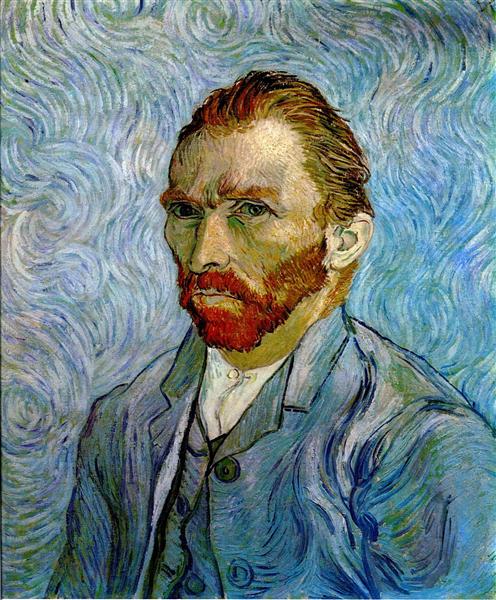
Vincent began to paint again including Self-Portrait with Bandaged Ear. He continued as an outpatient of the Arles Hospital and was visited in the Yellow House by Dr Félix Rey and other doctors who came to look at his pictures.
Vincent suffered another delusional attack in February and went back to hospital.
On 8 May he left Arles for Saint-Rémy de Provence where he was admitted as a voluntary patient at the Saint-Paul de Mausole psychiatric asylum. Vincent had a bedroom and an adjoining studio with barred windows. He was allowed to paint in the hospital grounds and, when accompanied by a hospital orderly, in the surrounding fields. He was attracted by the hospital garden where he painted Irises.
In August he had a further attack and while he was recovering, he was reluctant to leave the hospital and so painted Corridor in the Asylum. He continued to suffer many other breakdowns over the following months.
On 31 January 1890 Theo wrote to Vincent to tell him that he and his wife, Jo, had had a son whom they would call Vincent. To celebrate the birth, Vincent painted Almond Blossom.
Vincent was becoming unhappy with life in Saint-Rémy and he got to hear about Dr Paul Gachet, a physician with experience of working with psychiatric patients. Dr Gachet had a practice in Auvers-sur-Oise, to the north-west of Paris, and he was also an art collector.
Vincent travelled to Paris to stay with his brother for a few days and he met his sister-in-law and nephew for the first time. The walls of Theo’s flat were covered with Vincent’s pictures.
Vincent then travelled to Auvers where he met Dr Gachet. Vincent described him to his brother as ‘rather eccentric’. Vincent rented an attic room there. He painted Dr Gachet’s portrait and the doctor liked it so much that Vincent painted another one and gave it to him as a gift. The two got along very well. Vincent painted the Stairway at Auvers which was close to his lodgings.
On 6 July, Vincent went to Paris to see Theo, Jo and baby Vincent for the last time. Theo and Jo were worried about the baby who was ill and Theo was worried about money as his salary was very low. They quarrelled and Vincent left in a hurry. He described himself as ‘a burden’ in a letter to Theo.
Vincent painted Wheatfield with Crows which expressed his feelings of isolation and desperation. His last painting, Tree Roots, was unfinished.
Death
On the evening of 27 July 1890, Vincent, who had been painting in the Auvers countryside, shot himself in the chest with a revolver. He managed to walk back to his attic room without telling anyone what had happened. Eventually, he was found by the innkeeper, who called Dr Gachet and a local doctor. They decided not to remove the bullet and Dr Gachet contacted Theo who arrived the next day. Vincent died at 1.30 am on 29 July. He was 37 years old. He was buried in the cemetery in Auvers. Theo died six months later.
Legacy
When Vincent died, he had no money because he’d only sold one of his paintings, The Red Vineyard, in his entire life. His sister-in-law, Jo, inherited about 200 of his works and kept the collection, while selling a few pieces. The collection passed to her son, Vincent, when she died in 1925 and he transferred the collection to the Vincent van Gogh Foundation in 1962. In 1973 the Van Gogh Museum in Amsterdam opened.
During Vincent’s short, tortured life, he produced more than 2,000 works of art, nearly 900 of which were oil paintings and most of these were created within a ten-year period. So many artists have been influenced by his expressive style ever since and continue to be so. And we can enjoy his amazing works in museums and exhibitions around the world.
Text
Exercises
Answers
English Lessons with Jane Daly © 2026
Leave a Reply