
Click here to go straight to exercises.
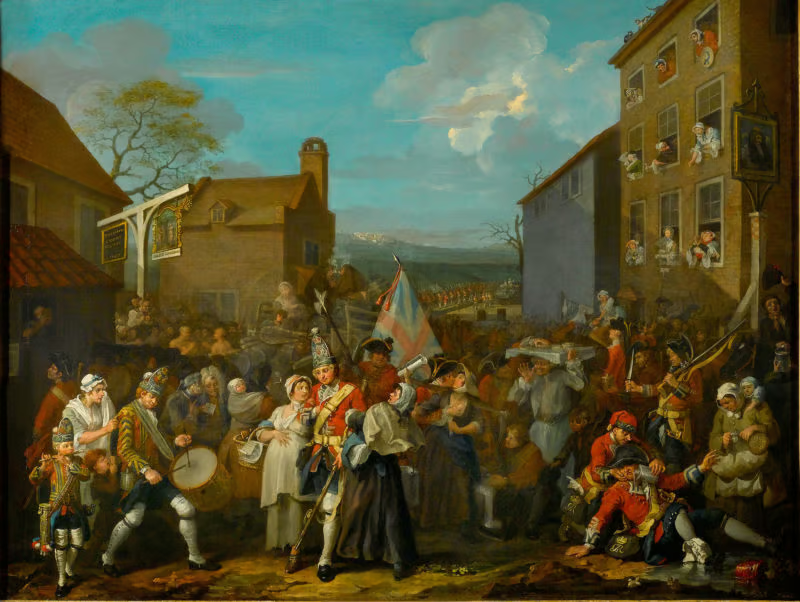
In this painting, Hogarth depicts English guards gathering to defend London from an uprising of supporters of the deposed James II and the Stuart dynasty, known as the Second Jacobite rebellion in 1745. Bonnie Prince Charlie’s invading army has just reached Derby.
The scene is set at the top of Tottenham Court Road on the northern edge of London. The guardsmen are gathering in preparation for their march to camp on Finchley Common. The painting shows the soldiers in a humorous light, emphasising their lack of training or respect for discipline.
In the middle, there is a guardsman with his wife. She is heavily pregnant and the couple represent the nuclear family, seen as ideal at the time. The woman is a ballad-seller and she is carrying a basket full of copies of ‘God Save the King’. She is holding onto the guardsman and holding her pregnant belly.
However, holding on to the guardsman’s other arm, is an older woman, dressed in dark priest’s robes and wearing a crucifix around her neck. She is holding a rolled up Jacobite newspaper above her head.
The guardsman seems to be in a dilemma: to support the King or the Jacobite rebellion. It’s been suggested that Hogarth’s painting symbolises the nation’s wavering between the Hanoverian Protestant King, George II, or the Scottish Stuart Catholic dynasty.
The picture is divided into two parts. The characters on the left represent things that are morally upright and decent. This is healthy, patriotic, Protestant Britain, as demonstrated by people drinking ale at the Adam & Eve tavern and manly boxing taking place outside. A crying woman and child are trying to hold onto the drummer who is likely to be going away with the regiment.
The other side of the picture represents vice, the main evil being Jacobitism – the movement to restore the Catholic House of Stuart to the British throne.
The soldier on the ground is completely drunk and perhaps being revived by his friend trying to pour water into his mouth but he doesn’t want it, he wants more gin. The woman with a baby on her shoulder is pouring it out for him.
The tall building on the right with the women hanging out of the windows is a brothel. The street vendor selling pies is being robbed by one soldier and another soldier is holding an upturned knife. Someone is stealing the milk from the milkmaid while she is being embraced by a soldier.
The painting was originally intended to be a gift to the King of England, George II. However, George was insulted by the portrayal of his best troops and rejected it. Hogarth was upset by the King turning down his offer and he changed the engraving and presented the painting to the King of Prussia, Frederick II, instead. Frederick was known for his skills as a soldier rather than an artist and he accepted the gift.
Hogarth was one of the founding governors of the Foundling Hospital – an early institution for the care of poor or abandoned children. The Hospital relied on fundraising but it wasn’t easy to attract donors as unmarried mothers were scorned by society.
Subscribers to the copperplate engraving of the painting could pay an extra 3 shillings for a lottery ticket that gave them the chance to win the original painting – a common method of promoting artists’ work in the 18th century. Hogarth gave all the unsold tickets to the Foundling Hospital and – to no-one’s surprise – one of these had the winning number. That’s how the painting ended up in the Foundling Museum where it can be seen today.
Hogarth even makes reference to the Hospital in the painting by including two abandoned chicks in the foreground.
Text
Exercises
Answers











Leave a Reply